
Why Teaching Sometimes Feels Misunderstood

Most teachers have experienced some version of the same moment.
You leave a lesson feeling that something real happened. Students were thinking. The room felt alive. Someone who usually stays quiet spoke up. A discussion took an unexpected turn and learners suddenly began using language in ways that felt genuine rather than rehearsed.
Then the observation feedback arrives.
The comments may mention pacing, clearer staging of activities, or whether instructions could have been simplified. None of these points are necessarily wrong. Yet they can feel strangely disconnected from what the teacher experienced in the room.
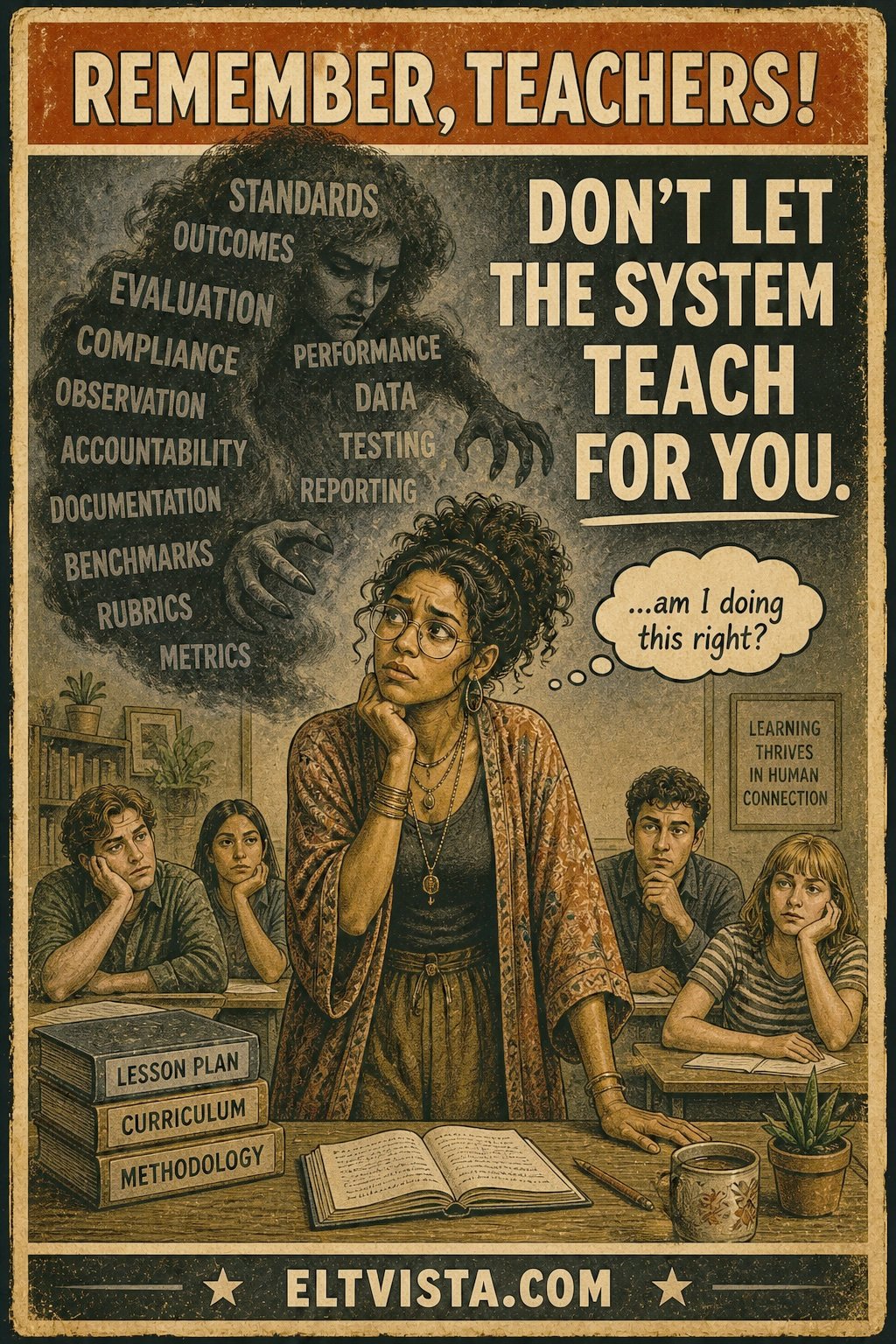
Something meaningful happened in the lesson, but the official language used to describe teaching seems to orbit around procedures rather than the learning itself.
Many teachers recognize this feeling immediately. Therefore, understanding where it comes from can change how we see our work.
When Quality Moved Into Systems
For most of the history of education, quality lived largely inside the craft of teaching. Teachers improved their practice through reflection, experience, and conversations with colleagues.
During the twentieth century, however, large organizations began searching for ways to ensure reliability across complex systems. One influential figure in this movement was W. Edwards Deming, an American statistician and management thinker whose work helped shape modern quality management in industry. Deming argued that quality problems are usually rooted in systems rather than individual workers (Deming, 1986).
These ideas proved powerful in fields such as manufacturing and engineering, where reliability is essential.
Over time, similar thinking began influencing education. As school systems expanded and institutions became responsible for larger numbers of learners, administrators needed ways to demonstrate consistency, accountability, and reliability.
Observation frameworks, teaching standards, and accreditation procedures gradually appeared as ways to provide visible evidence that classrooms were functioning according to recognized professional practices.
From an institutional perspective, this shift made sense. Yet teaching is not a production line.

The Problem of What Can Be Seen
Teaching belongs to what Donald Schön, an American philosopher who studied professional practice, called a reflective profession. In such professions, practitioners constantly interpret complex situations rather than simply applying fixed procedures (Schön, 1983).
Anyone who has spent time in a classroom understands why.
Learners bring different personalities, motivations, and anxieties. Some days a class feels curious and energetic. Other days the same group may appear distracted or hesitant. The teacher adjusts constantly.
Learning itself often develops slowly and sometimes invisibly. This creates a challenge for institutions because invisible things are difficult to measure. Observation systems therefore tend to focus on what can be seen:
- lesson stages
- task design
- interaction patterns
- board work
- timing of activities
These elements can provide useful signals about how a lesson is organized. Yet they remain signals rather than the learning itself.
Stephen Ball, a British sociologist of education known for his work on educational policy and accountability systems, describes this shift as a culture of performativity—an environment in which professional work must be displayed in recognizable ways so that institutions can evaluate it (Ball, 2003).
For teachers, this often explains the uneasy feeling that the deeper work of teaching sometimes slips past the formal language used to describe it.
Two Forms of Quality
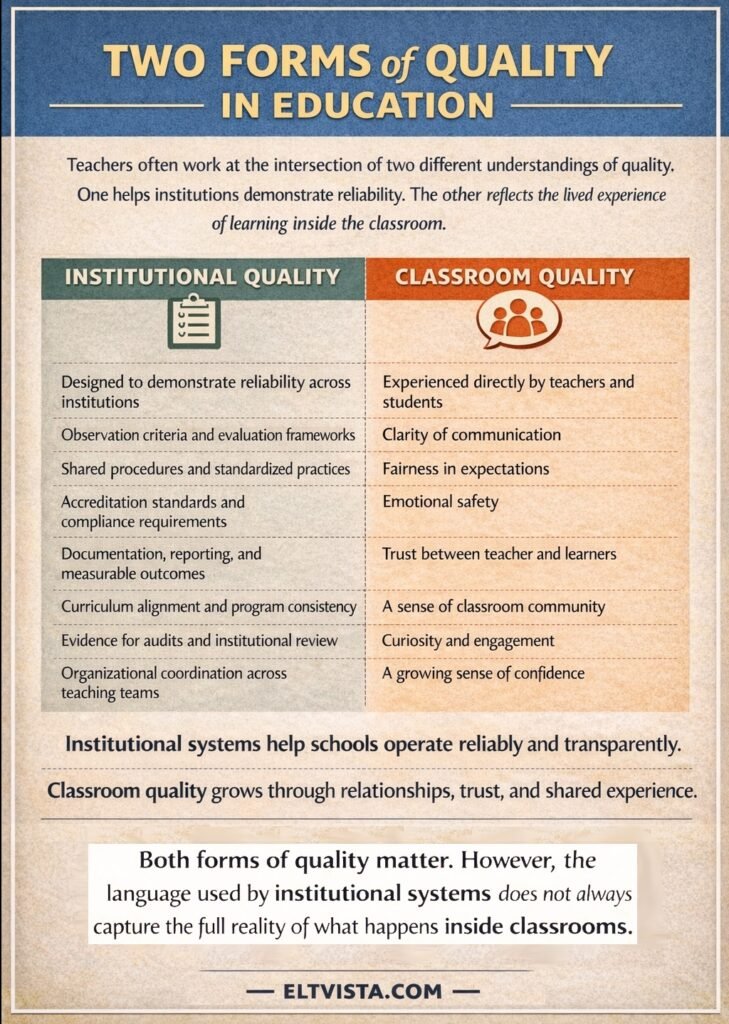
At this point, an important distinction begins to appear. Modern educational systems operate with two different understandings of quality.
The first might be called institutional quality.
Institutional quality refers to the systems organizations use to demonstrate reliability: observation criteria, shared procedures, accreditation standards, and documentation. These structures help institutions coordinate large teams of teachers and show that learning environments meet professional expectations.
The second might be called classroom quality.
Classroom quality is something teachers and students experience together. It appears in the daily life of the classroom, often through the gradual development of trust, shared expectations, and a sense of community:
- clarity of communication
- fairness in expectations
- emotional safety
- trust between teacher and learners
- a sense of classroom community
- curiosity and engagement
- a growing sense of confidence
These elements rarely fit neatly into checklists. Yet they strongly influence whether learning actually takes place.
The two forms of quality are not enemies. Institutions need systems that help them function reliably. However, the language used by those systems does not always capture the full reality of what happens in classrooms.
Understanding this distinction helps explain why teachers sometimes feel that important aspects of their work remain invisible.
The Part of Teaching That Cannot Be Standardized
Anyone who has taught long enough recognizes moments that resist standardization.
- A student who finally speaks after weeks of silence.
- A class that begins laughing together and suddenly feels safe.
- A discussion that drifts away from the textbook but becomes intellectually alive.
These moments rarely appear in lesson plans or observation rubrics. Yet they often signal that learning has become meaningful.
Lee Shulman, an American educational psychologist known for his work on teacher knowledge, argued that effective teaching depends on a complex form of professional understanding he called pedagogical content knowledge (Shulman, 1987). Teaching, in other words, is not simply the application of techniques but the thoughtful blending of subject knowledge, pedagogy, and understanding of learners.
Similarly, Andy Hargreaves and Michael Fullan, two influential scholars in teacher development and educational change, describe successful schools as relying on what they call professional capital—the collective expertise, judgment, and collaboration that develop among teachers over time (Hargreaves & Fullan, 2012).
These perspectives remind us that much of teaching’s quality lies in professional judgment and human relationships rather than in procedures alone.
What This Means for Teachers
Understanding how institutional systems interpret quality can be quietly liberating.
Observation frameworks and teaching standards exist primarily to help organizations recognize patterns of professional practice. They make teaching visible to institutions that must coordinate complex educational environments. However, they do not capture the entire story of learning.
Teachers therefore work at the intersection of two realities. One is the visible structure of teaching—the part institutions can observe and document. The other is the human experience of learning—the trust, curiosity, and engagement that develop between teachers and students over time.
Experienced teachers learn to navigate both. They meet institutional expectations while continuing to cultivate the deeper human conditions that allow learning to flourish. This balance is not merely technical. It reflects the teacher’s own growth and maturity within the profession.
What About the Teacher?
This brings the conversation back to the teacher’s own development.
Quality in teaching is not only something institutions attempt to measure. It is also something teachers cultivate through reflection, experience, and self-awareness. Teachers who continue examining their practice begin to notice that their own presence influences the classroom more than any particular technique.
Clarity of communication. Emotional steadiness. Curiosity about learners. The willingness to listen carefully and adapt. These qualities cannot be mandated by policy or fully captured in observation frameworks. Yet they shape the learning environment in powerful ways. In this sense, the teacher’s own professional and personal growth becomes part of the quality of the classroom.
At a practical level, this often means paying attention to the small conditions that allow a classroom community to develop. Simple routines that make learners feel oriented and included. Clear expectations that reduce anxiety. Moments where students feel safe enough to experiment with language rather than merely repeat it.
Teachers sometimes discover that these elements emerge less from technique and more from awareness. A teacher who listens carefully begins to notice which students are hesitant to speak. A teacher who reflects on classroom dynamics may recognize when an activity builds connection rather than simply completing a task.
Over time, these observations lead to small adjustments in practice. A teacher might begin a lesson with a short conversational check-in that invites students into the room. Another teacher might design tasks that require learners to rely on one another rather than simply respond to the teacher. Others may experiment with ways of acknowledging student ideas so that the classroom gradually becomes a place where learners feel their voices matter.
None of these practices appear dramatic. Yet together they contribute to something that observation rubrics rarely capture fully: a classroom that functions as a community of learners rather than a sequence of activities.
From a humanistic perspective, this may be one of the teacher’s most important contributions. Institutions may document procedures and evaluate visible structures, but teachers themselves shape the relational environment in which learning becomes possible.
Seen in this way, quality is not only something that systems attempt to measure. It is something teachers continue cultivating through attention, reflection, and their own ongoing development.
References
Ball, S. J. (2003). The teacher’s soul and the terrors of performativity. Journal of Education Policy, 18(2), 215–228.
Deming, W. E. (1986). Out of the Crisis. Cambridge, MA: MIT Press.
Hargreaves, A., & Fullan, M. (2012). Professional Capital: Transforming Teaching in Every School. New York: Teachers College Press.
Schön, D. A. (1983). The Reflective Practitioner: How Professionals Think in Action. New York: Basic Books.
Shulman, L. S. (1987). Knowledge and teaching: Foundations of the new reform. Harvard Educational Review, 57(1), 1–22.
If these questions resonate with your own teaching experience, it may be worth taking a look at the earlier articles in this series. The first article explores how teachers have long practiced quality through reflection and experience. The second article examines why consistency in classrooms is often misunderstood as uniformity.

While you are contemplating your personal and profesional development, please consider our self-paced 120-hour online certificate course to your list of teaching qualifications:
For more information, click here for the ELT Vista Certificate in Humanistic TESOL Teaching. Enrollment is now open!
Also, for more articles like this one, please consider our publication, What About The Teacher?—a humanistic guide to self-actualization for TESOL teachers seeking personal and professional development. The book is available online in both digital and paperback formats at: https://www.amazon.com/dp/B0FPBWNXTZ