
Part 3 of a short ELT Vista series exploring how learning outcomes, instructional design, accreditation systems, and quality-management frameworks gradually transformed educational tools into systems of legitimacy, standardization, and professional orthodoxy—and what happens when those systems encounter the unavoidable complexity of actual human learners.
The Human Problem

In the previous article, I argued that educational tools have a curious tendency to evolve into something much larger than their creators originally intended. What begins as a framework becomes an expectation. What begins as guidance becomes a requirement. What begins as an organizational tool gradually becomes a definition of professional legitimacy itself.
Yet an even more important question remains:
What happens when those systems encounter actual human beings?
This question matters because many of the most influential developments within TESOL over the past half century emerged precisely because teachers became increasingly dissatisfied with educational models that treated learners as though they moved through standardized pathways in predictable and uniform ways.
Communicative Language Teaching (CLT) challenged the assumption that language could be learned primarily through the isolated practice of grammatical structures. Task-Based Language Teaching (TBLT) pushed further by organizing learning around meaningful tasks rather than predetermined language items. Humanistic approaches, associated with educators such as Earl Stevick and Carl Rogers, emphasized affective factors, personal meaning, and the learner as a whole person. Learner autonomy questioned assumptions about teacher control and encouraged greater learner responsibility. Reflective teaching encouraged teachers to examine, adapt, and rethink their practice rather than merely implement prescribed procedures. Sociocultural perspectives, influenced by Vygotsky, increasingly highlighted interaction, mediation, and the social nature of learning itself.
More recently, Social-Emotional Learning (SEL) has renewed attention to the emotional, interpersonal, and developmental realities that shape educational experience.
Viewed individually, these developments may appear quite different from one another. Viewed collectively, however, they reveal a remarkably consistent pattern.
TESOL repeatedly moved toward greater recognition of human variability.
The profession repeatedly moved toward greater recognition of context.
The profession repeatedly moved toward greater recognition of interaction, identity, relationships, interpretation, and learner differences.
In short, TESOL increasingly moved toward people.
This did not happen because the profession became less rigorous, nor because teachers suddenly lost interest in planning, curriculum design, accountability, or educational effectiveness. It happened because teachers kept encountering the same reality inside actual classrooms.
Human beings are inconvenient.
Learners do not arrive carrying identical histories, motivations, fears, aspirations, personalities, cultural assumptions, or learning preferences. They do not learn at the same speed. They do not respond to the same activities. What works brilliantly with one learner may fail completely with another. What succeeds in one classroom may collapse in the next.
The deeper teachers looked at actual learning, the less it resembled an industrial process and the more it resembled a human one.
David Nunan’s work on learner-centered curriculum reflected this reality. Jack C. Richards emphasized curriculum development as something connected to learners, contexts, and classroom realities rather than merely procedural implementation. Leo van Lier explored ecological perspectives that highlighted the importance of context and interaction. Kumaravadivelu’s postmethod perspectives challenged the assumption that any single methodology could adequately address the complexity of all teaching situations.
Although these scholars differed in important ways, they shared a common concern:
Teaching could not be fully understood through universal prescriptions alone.
The closer one moved toward actual classrooms, the more complicated the picture became.
A curriculum document may describe a class of twenty learners progressing through the same lesson. The teacher standing in the room encounters twenty different experiences of that lesson. One learner may be struggling with confidence. Another may be dealing with anxiety. Another may be negotiating cultural expectations. Another may possess strong receptive skills but hesitate to speak. Another may already understand the target language yet remain disengaged from the task itself.
The curriculum sees a group.
The teacher encounters individuals.
This distinction matters because many of the methodologies that came to dominate TESOL emerged precisely as attempts to address these differences. CLT recognizes that learners develop language through communication. TBLT recognizes that meaningful tasks often generate learning opportunities that cannot be entirely predicted in advance. Learner autonomy recognizes that different learners require different pathways. Reflective teaching recognizes that teachers must continually adapt to realities that no curriculum document can fully anticipate. SEL approaches recognize that emotions, relationships, confidence, and belonging influence learning outcomes in ways that cannot be dismissed as secondary concerns.
Taken together, these traditions reveal something important.
They are not merely methodologies.
They are responses to the limitations of standardization.
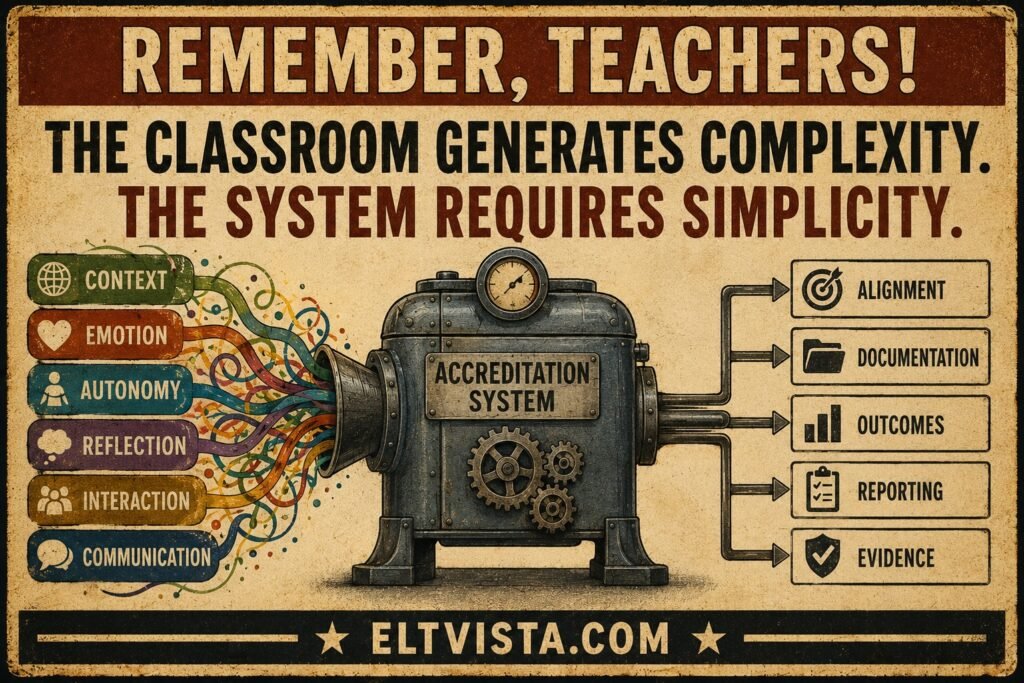
This is where the conflict discussed throughout this series or articles becomes increasingly visible.
Many accreditation systems rely heavily on alignment, documentation, measurable outcomes, standardized reporting, and externally verifiable evidence. Such systems are not irrational. Schools require organization. Institutions require accountability. Educational systems cannot function entirely through improvisation.
The difficulty emerges when organizational requirements begin colliding with the assumptions embedded within many of the profession’s most influential methodologies.
CLT assumes that meaningful communication matters.
TBLT assumes that learning may emerge unpredictably through tasks.
Learner autonomy assumes that different learners require different pathways.
Reflective teaching assumes that professional judgment matters.
SEL assumes that emotional realities influence educational outcomes.
Sociocultural approaches assume that learning is inseparable from context and interaction.
Yet operational systems function most comfortably when variability is reduced, processes are standardized, outcomes are predefined, and evidence is visible.
As such, the conflict is now apparent.
The profession increasingly moved toward complexity.
The systems increasingly moved toward simplification.
The profession increasingly emphasized difference.
The systems increasingly emphasized consistency.
The profession increasingly emphasized interpretation.
The systems increasingly emphasized compliance.
To be honest, neither side of this equation is entirely wrong.
However, the problem arises when one side begins pretending the other no longer exists.
This becomes especially visible when discussing teacher expertise. Many contemporary frameworks implicitly portray teaching as implementation. Teachers are expected to follow procedures, align outcomes, document evidence, demonstrate compliance, and satisfy externally imposed criteria. While such responsibilities may serve legitimate organizational purposes, they do not adequately describe what many experienced teachers actually do.
Experienced teachers observe, interpret, adapt, and respond. A teacher running a communicative activity may decide to extend a discussion because learners have become genuinely engaged. A task-based lesson may produce unexpected language that becomes more valuable than the originally planned target language. A learner’s emotional state may require adjustment of an activity. A classroom discussion may reveal needs, interests, or misunderstandings impossible to predict during lesson planning.
None of these decisions necessarily appear inside curriculum maps. None are easily captured through audit documentation. Yet many teachers would recognize them immediately as examples of professional expertise.
This is why the distinction between professional judgment and procedural compliance matters.
The issue is not whether standards should exist.
The issue is whether standards can ever fully replace interpretation.
The issue is not whether accountability matters.
The issue is whether accountability can adequately capture the realities of human learning.
The issue is not whether frameworks are useful.
The issue is whether frameworks should remain tools or become definitions of educational legitimacy itself.
Why is it, then, that accreditation organizations seem to care less about teacher experience, or about the realities of a TESOL program—as opposed to a math or history program? Why is it they look away when their accredited schools dismiss experience as an asset? Why is it they do not advocate for remuneration for experience?
If this tension is real, what might a more balanced system look like?

Toward a More Human System
The tension described here does not require abandoning standards, accountability, accreditation, or operational systems. It requires a more balanced understanding of what such systems can and cannot do.
One possibility is to broaden our understanding of evidence. Accreditation processes could recognize professional judgment as a legitimate form of evidence alongside traditional documentation. Reflective narratives, classroom-based decision logs, action research, adaptive teaching records, and documented examples of contextual responsiveness could complement more conventional measures of quality. Teacher evaluation should not treat procedural compliance as the sole indicator of expertise.
Curriculum frameworks can also preserve interpretive space. Standards may provide direction without functioning as rigid prescriptions. Learning outcomes may guide planning without becoming definitions of legitimacy. Curriculum maps may support consistency without eliminating responsiveness to local realities and learner needs.
Similarly, accountability systems can accommodate variability without automatically equating it with noncompliance. Educational systems inevitably require structure, but structure should not require pretending that all learners, classrooms, teachers, or contexts are identical. When systems privilege what is easiest to measure while overlooking what may matter most, they risk misrepresenting the realities they seek to govern.
None of these proposals require abandoning standards or systems. They require acknowledging their limitations.
Frameworks are useful.
Systems are useful.
Standards are useful.
But none of them are the learner.
None of them are the classroom.
And none of them should be mistaken for learning itself.
The map remains useful.
The territory remains real.
The problem begins only when one is mistaken for the other.
Other Articles in this series.
Part 1: The CEFR, Can Do Statements, and the Confusion Around Learning Outcomes
Part 2: From “Can Do” Statements to Institutional Orthodoxy
Suggested Reading
For readers interested in exploring some of the historical, curricular, and humanistic traditions discussed in this article, the following works provide useful starting points:
- David Nunan — The Learner-Centred Curriculum (1988)
- Jack C. Richards — Curriculum Development in Language Teaching (2001)
- Earl W. Stevick — A Way and Ways (1980) Carl Rogers — Freedom to Learn (1969)
- Leo van Lier — The Ecology and Semiotics of Language Learning (2004)
- B. Kumaravadivelu — Understanding Language Teaching: From Method to Postmethod (2006)
- Lev Vygotsky — Mind in Society (1978)
The inclusion of these works should not be interpreted as endorsement of every idea discussed in this article. Rather, they represent influential contributions to the broader conversations surrounding curriculum design, instructional systems, communicative language teaching, learner-centered education, and humanistic approaches to teaching and learning.
While you are contemplating your personal and profesional development, please consider our self-paced 120-hour online certificate course to your list of teaching qualifications:
For more information, click here for the ELT Vista Certificate in Humanistic TESOL Teaching. Enrollment is now open!
Also, for more articles like this one, please consider our publication, What About The Teacher?—a humanistic guide to self-actualization for TESOL teachers seeking personal and professional development. The book is available online in both digital and paperback formats at: https://www.amazon.com/dp/B0FPBWNXTZ