


Skip to content
ELT Vista

ELT Vista

Personal and Professional Development for TESOL Teachers

  • About Us
    • Newsletter
    • Privacy Policy
  • Contact Us
  • Courses
    • ELT Vista Certificate in Humanistic TESOL Teaching
    • Courses Overview
  • Publications
    • What About The Teacher?
  • Services
  • Articles for TESOL Teachers
  • Toggle search form

Author: Jay Leonard Schwartz

Writer, Creative, TESOL Teacher/Teacher-Trainer, Education Consultant, Academic Materials-Developer, Musician, Filmmaker. Independent Author

Earth Day: When the Ocean Speaks Back

Posted on April 21, 2026April 21, 2026 By Jay Leonard Schwartz
Earth Day: When the Ocean Speaks Back

Earth Day, the Anthropocene, and the Language Classroom:
Bringing Environmental Responsibility into the Conversation

ELTIVSTA.COM, EARTH DAY, TESOL

Each year Earth Day encourages reflection on the condition of the planet we share—and what we have done to it. In recent decades, scientists and historians have increasingly used the term Anthropocene to describe our present moment, a proposed geological era in which human activity has become a dominant force shaping the Earth’s climate, oceans, and ecosystems more so for the worse.

The idea is unsettling.

For most of human history, nature molded civilization. Yet today, civilization increasingly deforms nature. Forests disappear in decades rather than in centuries. Glaciers that took thousands of years to form are melting within a generation. Oceans that once seemed vast enough to absorb anything are now showing unmistakable signs of stress, as well as our refuse.

Read More “Earth Day: When the Ocean Speaks Back” »

Blog

All Dogs Must Wear Pants: When the Ridiculous Becomes Communicative

Posted on April 3, 2026April 4, 2026 By Jay Leonard Schwartz
All Dogs Must Wear Pants: When the Ridiculous Becomes Communicative
An Absurd Suggestion from the Constituents
CLT, SEL, ELT Vista, eltvista.com

Imagine presenting the following situation to a class.

A newly formed political party has invited suggestions from its local constituents about laws that might improve the community. Party members must review the proposals and decide which ones should become official policy. Among the suggestions submitted is the following:

All dogs must wear pants in public.

Students are members of the political party. Their task is to discuss the proposal and decide whether the party should officially propose the law.

To reach a decision, they might discuss questions such as:

  • Why would someone propose this law?
  • Who might benefit from it?
  • What problems could it create?
  • Would it apply to all animals?

The premise is obviously ridiculous. Yet the interaction that follows often becomes surprisingly lively. Students debate practicality, fairness, ethics, modesty, enforcement, and even fashion. They interrupt one another with alternative ideas. They defend positions and challenge arguments. They comment on how ludicrous the whole thing is because animals are not people, etc.

The scenario is absurd. The communication, however, is real.

Read More “All Dogs Must Wear Pants: When the Ridiculous Becomes Communicative” »

Blog

From Quality to Consistency—Where the Meaning Changed

Posted on February 27, 2026 By Jay Leonard Schwartz
From Quality to Consistency—Where the Meaning Changed
Why Reliable Classrooms Rarely Look Identical
Good Teaching, Humanistic Education, ELT Vista, Quality Management

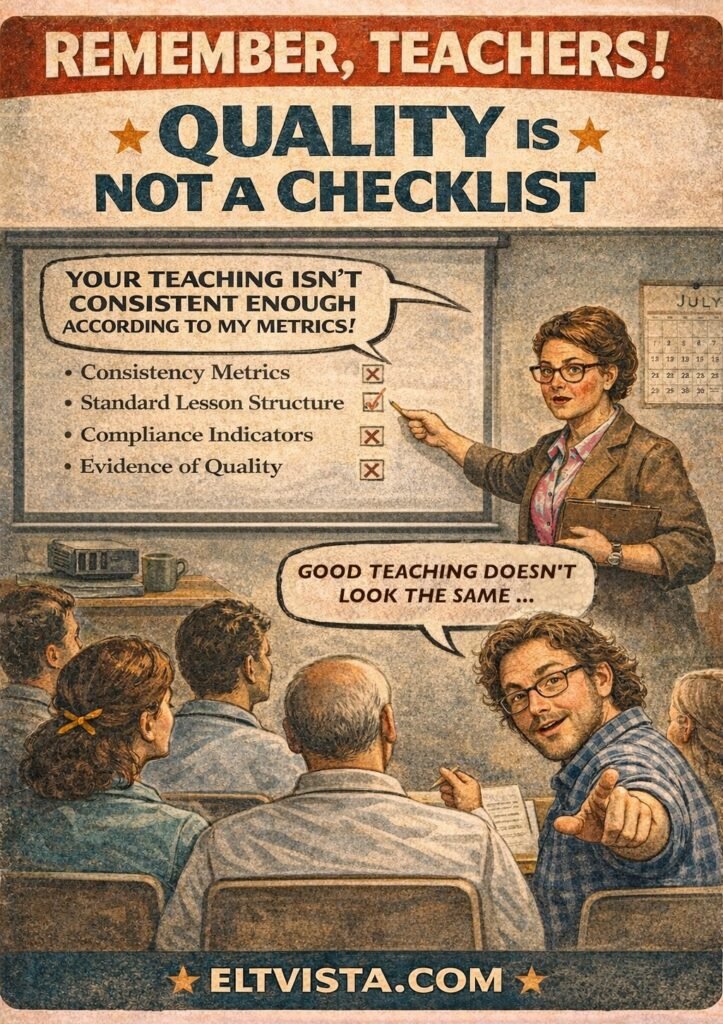
In a previous article, we explored the idea that teachers have always been engaged in quality thinking. Long before the language of audits, standards, and accreditation entered education, teachers were already reflecting on lessons, noticing patterns, and making small adjustments to improve learning over time. In other words, quality has long existed inside classroom practice under a different name: experience.

However, once the conversation shifts from quality to consistency, a new discomfort often appears. For many teachers, the word consistency feels far less comfortable than the word quality.

Read More “From Quality to Consistency—Where the Meaning Changed” »

Blog

The Classroom Is Already a System

Posted on February 20, 2026February 25, 2026 By Jay Leonard Schwartz
The Classroom Is Already a System
Rethinking Quality from the Inside Out
Quality Management, TESOL, eltvista.com

The phrase quality management rarely excites classroom teachers. For many, it conjures images of accreditation visits, institutional audits, observation rubrics, and administrative paperwork. It sounds managerial, corporate, and distant from the daily realities of teaching. Most teachers assume that quality management is something handled by directors of studies, academic managers, or school owners rather than by the person standing in front of the class.

For many teachers, the phrase feels imported from another world—one of audits, checklists, and accreditation visits rather than lesson planning and learner relationships. This distance matters, because it shapes how teachers respond to the idea before the conversation even begins.

However, in truth, this assumption deserves a closer look. Because long before institutions began measuring quality, teachers were already trying to improve it.

Read More “The Classroom Is Already a System” »

Blog

Teaching Beyond Inherited Systems

Posted on February 15, 2026February 16, 2026 By Jay Leonard Schwartz
Teaching Beyond Inherited Systems
Question What Was Once Unquestioned ELTvista

Not long ago, I wrote about the distinction between presence and authority in the classroom. The response to that piece suggested that many teachers recognize the tension instinctively. This article moves the conversation forward, because once we begin questioning authority, a larger question emerges: Where did our classroom habits come from in the first place?

Teachers inherit more than lesson plans and coursebooks. We inherit systems, expectations, and professional instincts that were shaped long before we entered the classroom. Some of these inheritances serve us well. Others remain simply because they have always been there—and what’s problematic to me is that this seems to be the only reason they continue to be embraced: they are venerable, sacrosanct, ossified, and fossilized.

Read More “Teaching Beyond Inherited Systems” »

Blog

When “Pay Attention” Isn’t Enough: Teacher Language, Presence, and the Humanistic Classroom

Posted on February 7, 2026 By Jay Leonard Schwartz
When “Pay Attention” Isn’t Enough: Teacher Language, Presence, and the Humanistic Classroom
TESOL, ELT Vista, Humanistic Education, eltvista.com

You are about to enter another dimension—not only of sight and sound, but of mind. A place where expectation meets interruption. Next stop: the classroom.

You are already in the middle of the lesson. The grammar point is unfolding exactly as planned. Examples sit on the board. Your explanation is measured and clear. Yet the room is drifting. You sense the disconnect and wandering eyes.

A glow from handheld screens. Fingers scrolling. A backpack unzipped. Someone whispering. Eyes moving everywhere except toward you. A bag of potato chips is opened.

Tensely, you pause, allowing the moment to correct itself, but it does not. You reach, almost instinctively, for imperative speech—the professional language of control many teachers have been conditioned to trust.

“Pay attention!”

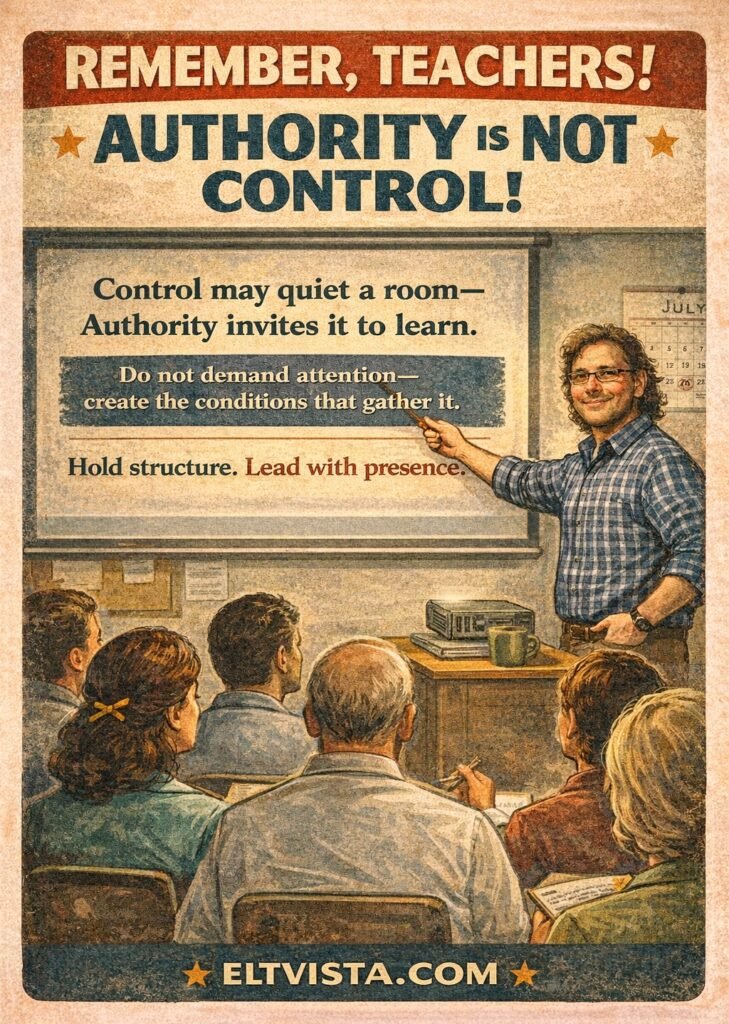
Your intention is entirely sound. You want to teach. You want the class with you. You want your preparation —and your professionalism—to matter. You want respect. You demand respect. You are the authority.

The words land. The room quiets, at least on the surface. And yet, you sense that something still is missing. Students may comply, yet they are not fully present.

And you feel the added tension immediately, because beneath imperative speech lies something deeply human: the desire to be taken seriously and to know that your voice carries weight.

So it is worth asking, if only for a moment:

What are you hoping to do with the attention you are demanding? To move through the explanation? To secure the grammar point? Ensure the lesson proceeds as intended?

After all, learning does not occur simply because a room grows quiet. Students can obey an imperative without ever entering the thinking. Perhaps, then, the deeper question is not whether students are paying attention. Perhaps it is what makes attention possible in the first place.

Read More “When “Pay Attention” Isn’t Enough: Teacher Language, Presence, and the Humanistic Classroom” »

Blog

SEL, Emotional Intelligence, and Gratitude: A Practical View from the Language Classroom

Posted on January 26, 2026January 26, 2026 By Jay Leonard Schwartz
SEL, Emotional Intelligence, and Gratitude: A Practical View from the Language Classroom
Emotions Are Not Extra in Language Learning
Building Emotional Awareness ELT Vista

Most language classrooms are very good at helping students notice what went wrong. Much less time is spent helping them notice what helped. That imbalance matters. Over time, it shapes how learners experience risk, error, feedback—and ultimately, the language itself.

This is where gratitude enters the picture, though not in the way it is often understood. In the language classroom, gratitude is not about politeness or forced positivity. It is about attention—the ability to notice what supported learning while it was happening, rather than only what fell short afterward. In a humanistic TESOL context, gratitude is better understood as an attentional practice: a way of noticing value, effort, and relational contribution in real time.

Read More “SEL, Emotional Intelligence, and Gratitude: A Practical View from the Language Classroom” »

Blog

Humanism Without Distance: What MLK Still Asks of Teachers

Posted on January 17, 2026January 17, 2026 By Jay Leonard Schwartz
Humanism Without Distance: What MLK Still Asks of Teachers
MLK, ELT Vista, Humanism

Every year we quote Martin Luther King Jr.
Every year we praise his moral clarity, his courage, his vision of justice and dignity.

At the same time, teachers are told to “be humanistic,” “be learner-centered,” and “support the whole learner” while working under conditions that quietly make dignity harder, not easier, to sustain.

That contradiction is not accidental—and King would have recognized it immediately.

King’s work did not emerge from abstract moral concern. It emerged from material realities faced by African Americans: segregated schools, suppressed wages, restricted housing, blocked civic participation. When he spoke of justice, he spoke about conditions—who carried risk, who absorbed instability, and who was expected to wait patiently while inequality remained intact.

He was clear on one point: moral language without material change is not progress. It is delay.

For teachers, that insight lands close to home.

Read More “Humanism Without Distance: What MLK Still Asks of Teachers” »

Blog

Open Communication, Empathy, and Difficult Conversations

Posted on January 7, 2026 By Jay Leonard Schwartz
Open Communication, Empathy, and Difficult Conversations

In many classrooms, teachers avoid topics like climate change because they fear conflict or discomfort. Yet avoiding difficult topics does not teach students how to communicate about them—it simply postpones the problem.

Blog

Grades, Judgment, and the Machinery of Worth

Posted on January 4, 2026January 4, 2026 By Jay Leonard Schwartz
Grades, Judgment, and the Machinery of Worth

Grades, Judgment, and the Machinery of Worth

Grades are Signals

Nobody ever tells students the most dangerous thing about grades:
they don’t just measure performance—they train you to outsource your sense of worth.
They feel neutral and necessary. That’s exactly why they’re dangerous.

Grading is a necessary evil in education. Necessary, because institutions require some way to sort, credential, and move people through systems at scale. Evil—not in a melodramatic sense, but in a quiet, corrosive one—because grades are so easily mistaken for something they are not.

A grade is information. It is a signal within a bounded system. It is not a measure of human worth, potential, or legitimacy. Most students are never explicitly told this, which is why the signal so easily becomes a verdict. Unless that caveat is made explicit, students absorb something far more dangerous than the grade itself: the idea that judgment arrives from elsewhere, and that its verdict is final.

This is where the real injustice begins. Not because the system is intentionally cruel, but because it is largely silent about what its judgments are meant to mean—and what they are not.

Read More “Grades, Judgment, and the Machinery of Worth” »

Blog

Posts pagination

1 2 Next

Copyright ©2024 ELT Vista, Jay Leonard Schwartz.

Powered by PressBook Green WordPress theme