Part 1 of a short ELT Vista series exploring learning outcomes, CEFR descriptors, operationalization, accreditation culture, and the growing tension between standardized educational systems and the human realities of language learning.
The Historical Confusion
It was recently suggested to me that all learning outcomes came from the CEFR Can Do statements.
Historically, this is inaccurate. However, pedagogically, the misunderstanding also reveals something much larger about modern language education and how easily different ideas become collapsed into a single narrative. If this were merely a matter of correcting revisionist history, the issue would be relatively minor. My concern, however, extends to how this false narrative affects real students, real teachers, and real classrooms—in other words, the human arena itself.
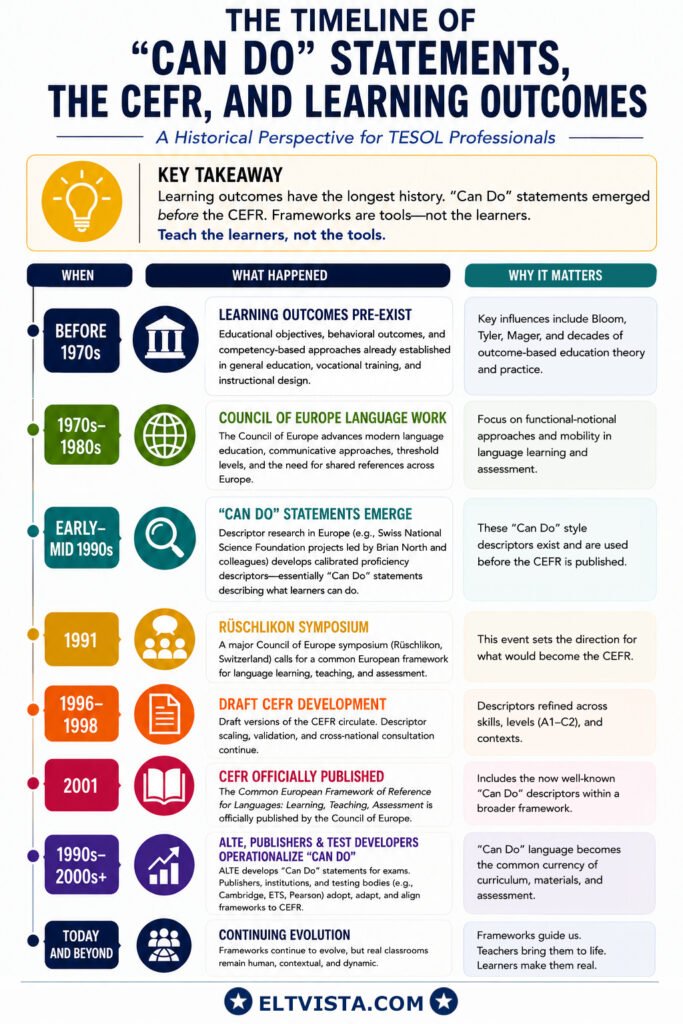
Learning outcomes did not suddenly appear with the Common European Framework of Reference for Languages (CEFR). Educational systems had already been working with objectives, competencies, performance criteria, behavioral outcomes, and various forms of outcome-based education for decades before the CEFR was formally published in 2001. Figures such as Benjamin Bloom, Ralph Tyler, and Robert Mager had already contributed significantly to broader educational theories surrounding objectives and measurable performance long before the CEFR emerged from the work of the Council of Europe.
The CEFR descriptors themselves were heavily informed by communicative-functional approaches and descriptor research during the 1990s, particularly through the work of Brian North and related European language assessment projects. In other words, the Can Do descriptors were not the origin of learning outcomes themselves. Rather, they were part of a much larger educational and assessment tradition already developing internationally.
However, over time, these distinctions became blurred. Publishers, examinations, institutions, curriculum systems, accreditation structures, and commercial educational ecosystems increasingly operationalized Can Do language so successfully that many teachers understandably began associating learning outcomes almost exclusively with CEFR-style descriptors.
Why Can Do Statements Work So Well at Lower Levels
To be fair, there are understandable reasons why the Can Do model became so influential.
At lower and intermediate levels, the functional Can Do framework works remarkably well because communicative behavior is often observable and measurable:
- Can ask for directions.
- Can order food in a restaurant.
- Can participate in routine workplace interactions.
- Can express opinions on familiar topics.
- Can write a basic formal email.
These are visible, practical communicative outcomes. They align naturally with communicative language teaching, functional English, workplace communication, and many real-world language needs. At the A1 to B2 range especially, the relationship between communicative purpose and observable performance often feels relatively concrete.
This is precisely why such descriptors became so attractive to institutions, publishers, accreditation systems, and curriculum designers. Observable outcomes create the appearance of clarity. They can be mapped onto syllabi, assessed through standardized procedures, and displayed neatly inside curricular documentation.
In other words, they fit modern institutional logic extremely well.
Where the Model Begins to Strain
However, something interesting begins to happen as learners move toward C1 and C2 levels.
Language gradually becomes less transactional and increasingly interpretive, rhetorical, sociocultural, and identity-driven. Advanced communication is no longer simply about successfully completing tasks. It involves nuance, register, ambiguity, interpersonal sensitivity, implied meaning, humor, irony, hedging, metaphor, cultural framing, and the ability to shift language strategically depending on context.
At that point, the neatness of the Can Do model begins to strain under its own weight.
After all, how exactly do we operationalize:
- subtle irony,
- rhetorical elegance,
- emotional nuance,
- intercultural sensitivity,
- strategic ambiguity,
- or the ability to navigate complex social dynamics through language?
A learner at C2 may technically “communicate effectively,” yet what often distinguishes highly advanced users is precisely their ability to manipulate tone, implication, identity, and context in ways that resist neat categorization.
This is where I sometimes think modern TESOL risks confusing the map with the territory.
Frameworks can be useful.
Descriptors can be useful.
Learning outcomes can absolutely be useful.
However, none of these things are the learner.
Conclusion: The Map Is Not the Territory
That shift may seem relatively harmless on the surface. However, it also hints at something larger, perhaps more disconcerting, about the direction modern education itself has increasingly taken: the desire to operationalize, standardize, measure, align, and systematize human learning as visibly and efficiently as possible.
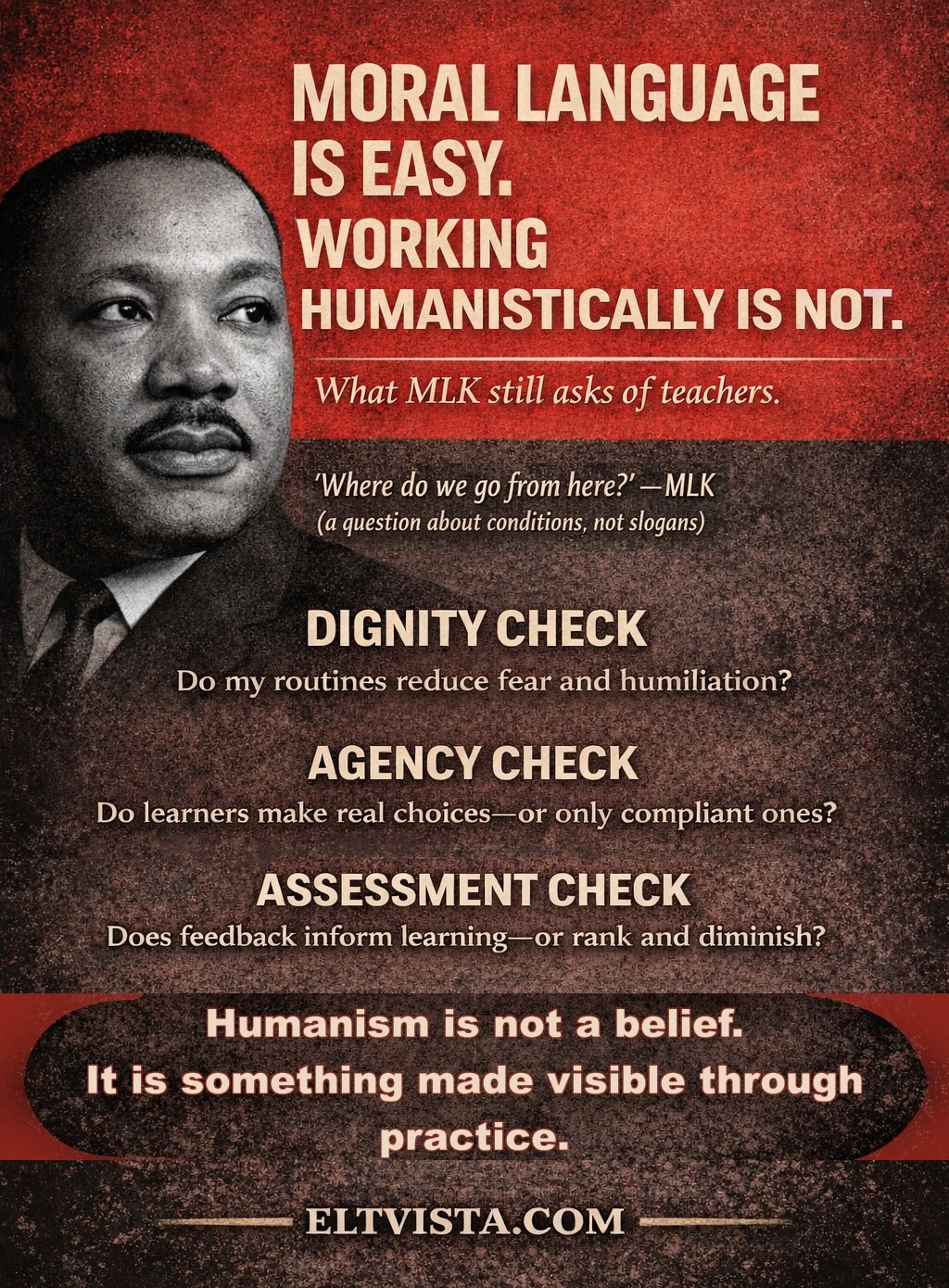
To be fair, educational frameworks can absolutely serve useful purposes. They can help organize curricula, establish shared expectations, create continuity, and support assessment. However, problems begin when frameworks slowly stop functioning as guides and start functioning as substitutes for the learners themselves.
TESOL increasingly embraced humanistic and learner-centered principles. At the same time, institutional systems simultaneously moved toward stronger standardization, alignment, audit culture, and measurable compliance.
Perhaps this tension becomes most visible at advanced proficiency levels, where language increasingly resists neat operationalization. Human communication is not always tidy, measurable, or easily standardized. It is often emotional, contextual, interpersonal, interpretive, and deeply connected to identity itself.
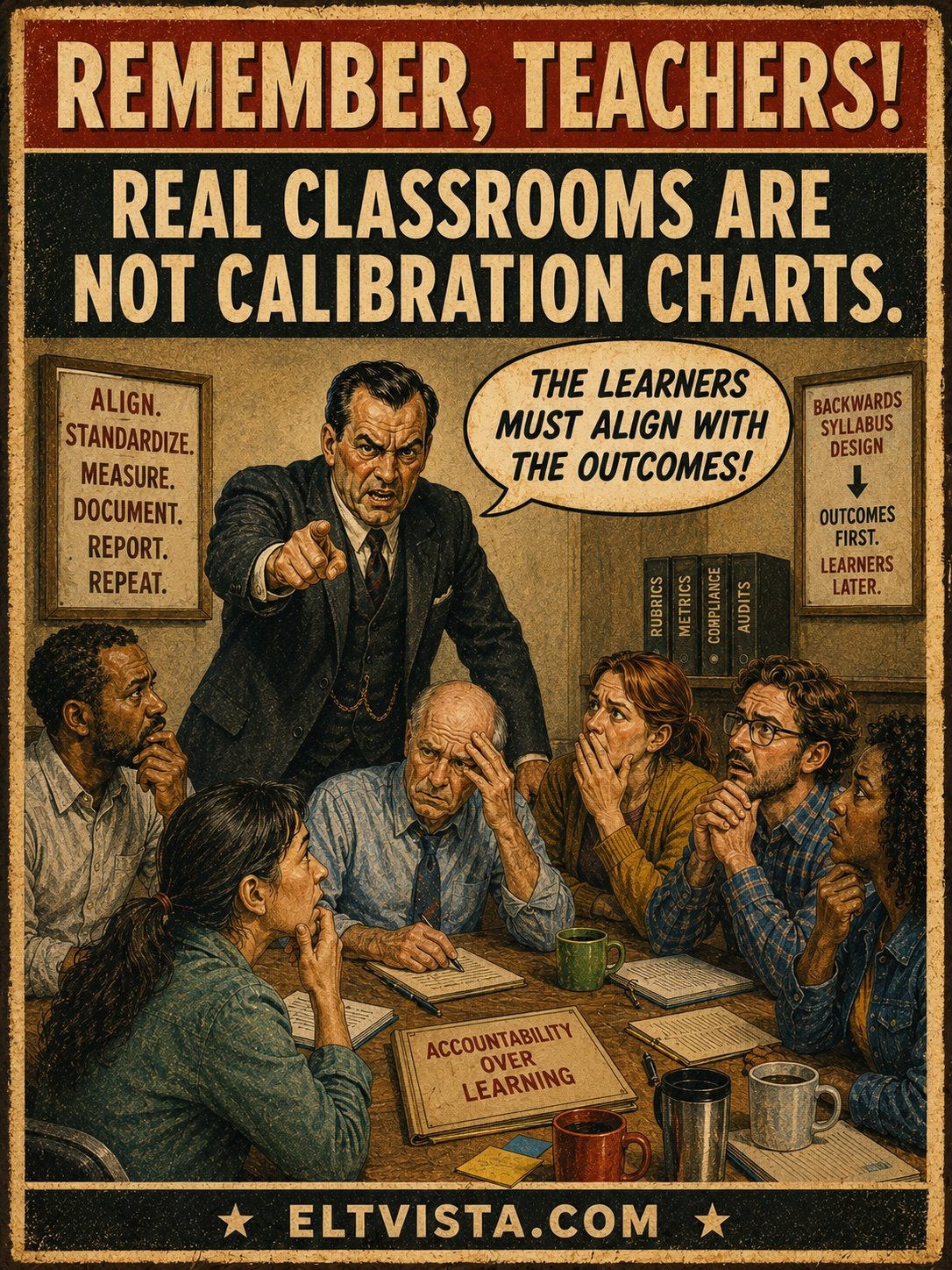
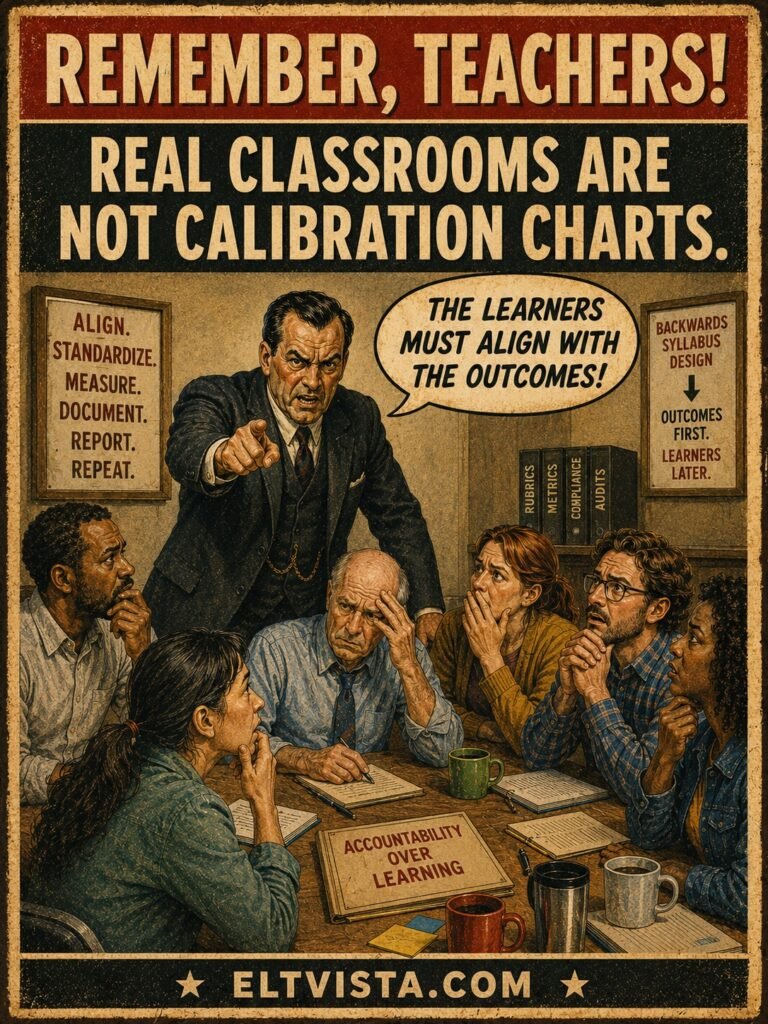
This is why experienced teachers so often adapt materials, reinterpret activities, slow down, speed up, follow unexpected classroom energy, or respond to needs that no descriptor fully predicted in advance. Real classrooms are living human systems rather than calibration charts.
Most experienced teachers understand the value of planning, sequencing, assessment, and clear objectives. However, the teacher’s role is not merely to “deliver” outcomes, but to interpret them responsively through the lived reality of actual learners sitting in the room.
Sometimes students need the syllabus.
Sometimes they need reassurance.
Sometimes they need communicative challenge.
Sometimes they need confidence before accuracy.
Sometimes they need structure.
Sometimes they need space.
No framework can fully predict those moments in advance because classrooms are social environments rather than controlled systems.
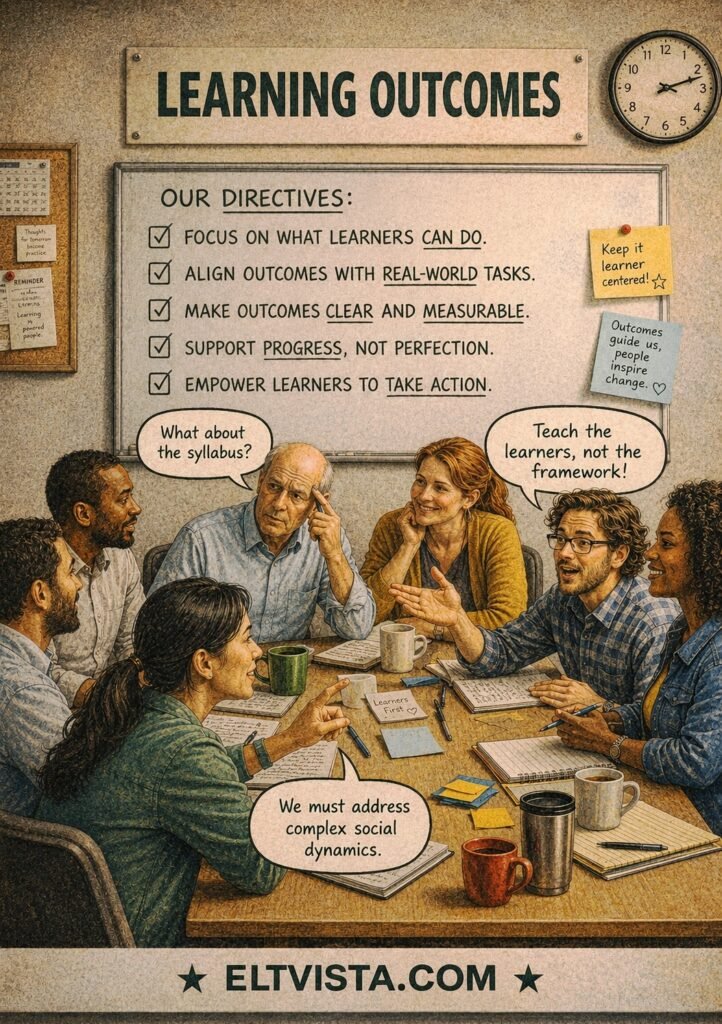
We are not failing the framework because we are not teaching the framework; we are teaching the learners. And always, frameworks, syllabi, materials, and methodologies must ultimately be wrapped around the learners—not the other way around.
It also raises, once again, the issue of authoritarianism quietly creeping back into spaces that once saw themselves as fundamentally humanistic.
In the next article, we will explore this issue further—particularly regarding accreditation culture, backward syllabus design, measurable outcomes, and the growing tension between institutional systems and the human realities of actual classrooms.
While you are contemplating your personal and profesional development, please consider our self-paced 120-hour online certificate course to your list of teaching qualifications:
For more information, click here for the ELT Vista Certificate in Humanistic TESOL Teaching. Enrollment is now open!
Also, for more articles like this one, please consider our publication, What About The Teacher?—a humanistic guide to self-actualization for TESOL teachers seeking personal and professional development. The book is available online in both digital and paperback formats at: https://www.amazon.com/dp/B0FPBWNXTZ