
Skip to content
ELT Vista

ELT Vista

Personal and Professional Development for TESOL Teachers

  • About Us
    • Newsletter
    • Privacy Policy
  • Contact Us
  • Courses
    • ELT Vista Certificate in Humanistic TESOL Teaching
    • Courses Overview
  • Publications
    • What About The Teacher?
  • Services
  • Articles for TESOL Teachers
  • Toggle search form

Tag: Learner-Centered Teaching

The CEFR, Can Do Statements, and the Confusion Around Learning Outcomes

Posted on May 16, 2026May 16, 2026 By Jay Leonard Schwartz
The CEFR, Can Do Statements, and the Confusion Around Learning Outcomes

Part 1 of a short ELT Vista series exploring learning outcomes, CEFR descriptors, operationalization, accreditation culture, and the growing tension between standardized educational systems and the human realities of language learning.

The Historical Confusion
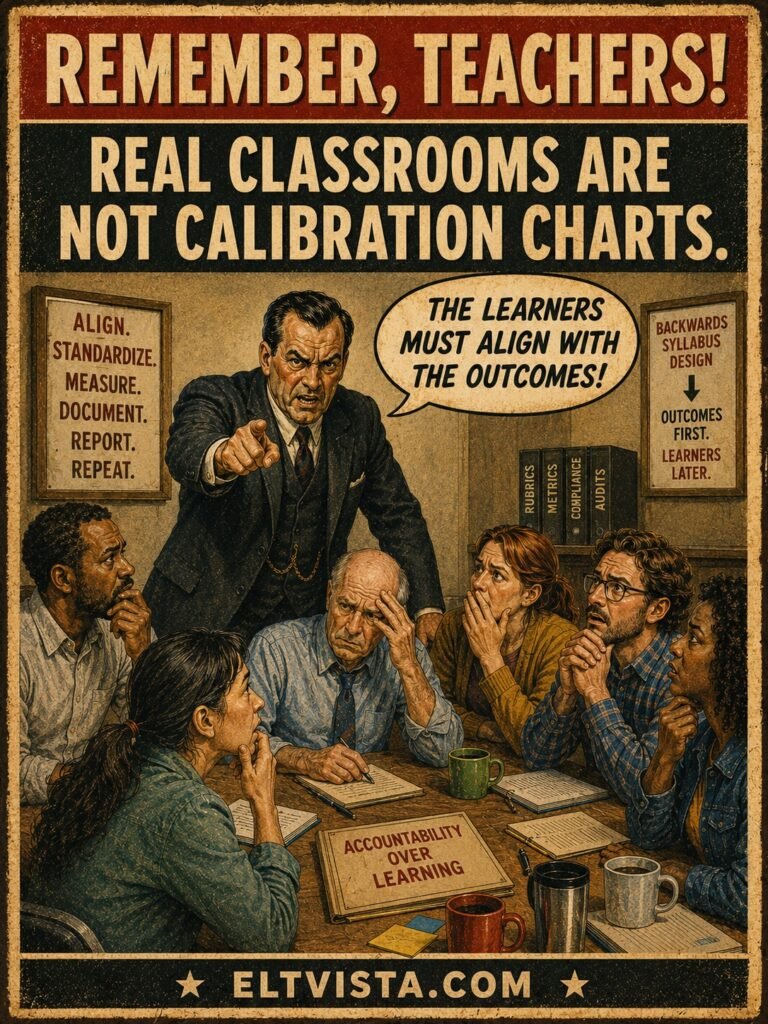
CEFR LO CANDO AUTHORITY

It was recently suggested to me that all learning outcomes came from the CEFR Can Do statements.

Historically, this is inaccurate. However, pedagogically, the misunderstanding also reveals something much larger about modern language education and how easily different ideas become collapsed into a single narrative. If this were merely a matter of correcting revisionist history, the issue would be relatively minor. My concern, however, extends to how this false narrative affects real students, real teachers, and real classrooms—in other words, the human arena itself.

Learning outcomes did not suddenly appear with the Common European Framework of Reference for Languages (CEFR). Educational systems had already been working with objectives, competencies, performance criteria, behavioral outcomes, and various forms of outcome-based education for decades before the CEFR was formally published in 2001. Figures such as Benjamin Bloom, Ralph Tyler, and Robert Mager had already contributed significantly to broader educational theories surrounding objectives and measurable performance long before the CEFR emerged from the work of the Council of Europe.

The CEFR descriptors themselves were heavily informed by communicative-functional approaches and descriptor research during the 1990s, particularly through the work of Brian North and related European language assessment projects. In other words, the Can Do descriptors were not the origin of learning outcomes themselves. Rather, they were part of a much larger educational and assessment tradition already developing internationally.

However, over time, these distinctions became blurred. Publishers, examinations, institutions, curriculum systems, accreditation structures, and commercial educational ecosystems increasingly operationalized Can Do language so successfully that many teachers understandably began associating learning outcomes almost exclusively with CEFR-style descriptors.

Read More “The CEFR, Can Do Statements, and the Confusion Around Learning Outcomes” »
Blog

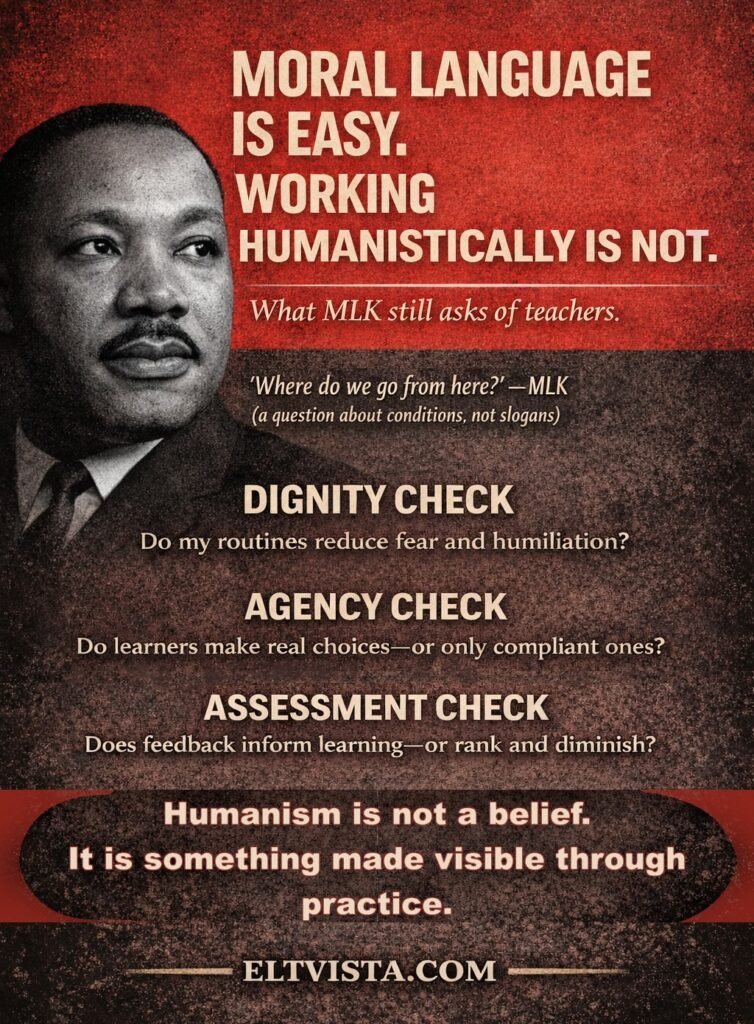
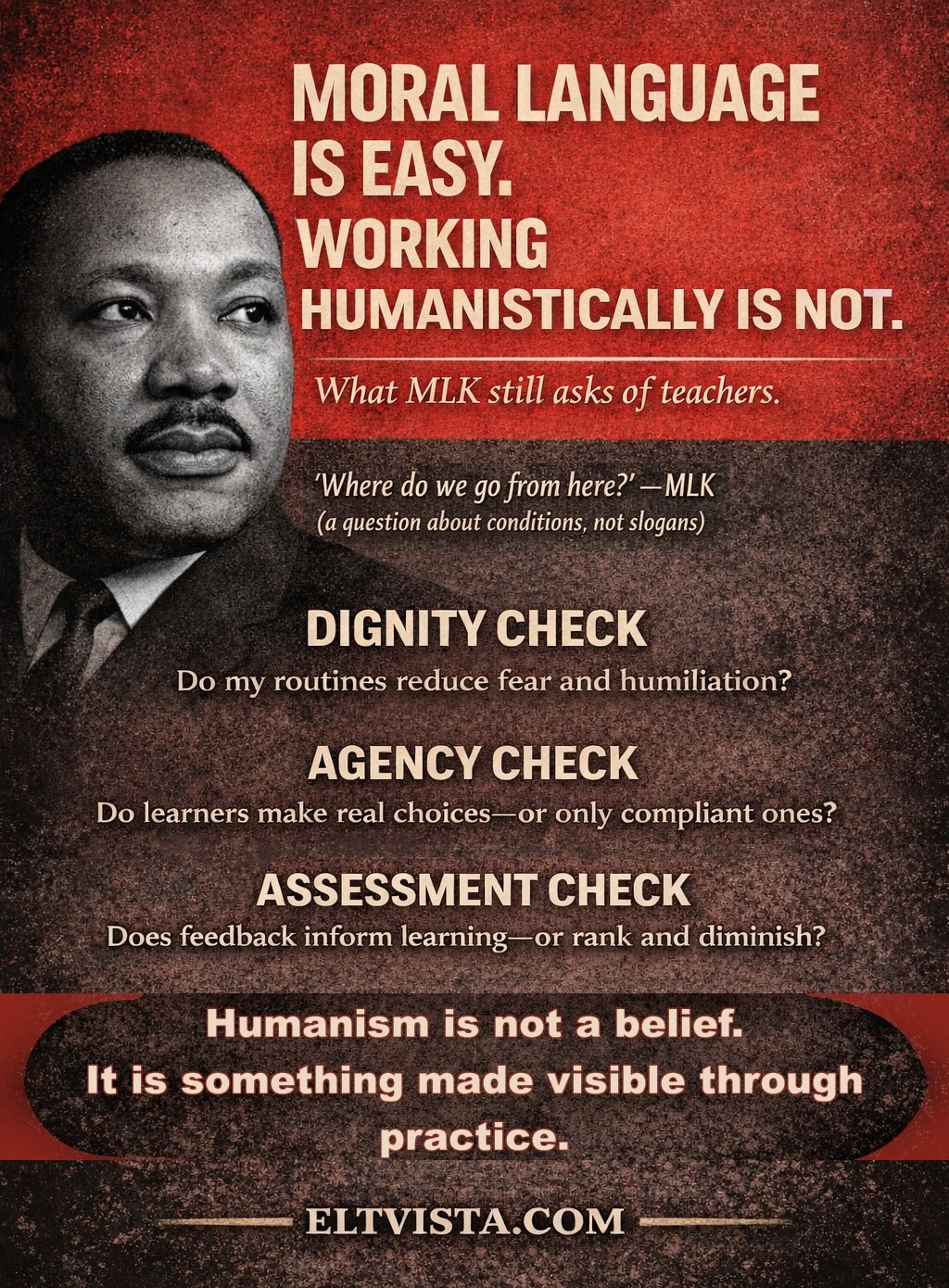
Humanism Without Distance: What MLK Still Asks of Teachers

Posted on January 17, 2026January 17, 2026 By Jay Leonard Schwartz
Humanism Without Distance: What MLK Still Asks of Teachers
MLK, ELT Vista, Humanism

Every year we quote Martin Luther King Jr.
Every year we praise his moral clarity, his courage, his vision of justice and dignity.

At the same time, teachers are told to “be humanistic,” “be learner-centered,” and “support the whole learner” while working under conditions that quietly make dignity harder, not easier, to sustain.

That contradiction is not accidental—and King would have recognized it immediately.

King’s work did not emerge from abstract moral concern. It emerged from material realities faced by African Americans: segregated schools, suppressed wages, restricted housing, blocked civic participation. When he spoke of justice, he spoke about conditions—who carried risk, who absorbed instability, and who was expected to wait patiently while inequality remained intact.

He was clear on one point: moral language without material change is not progress. It is delay.

For teachers, that insight lands close to home.

Read More “Humanism Without Distance: What MLK Still Asks of Teachers” »

Blog

Open Communication, Empathy, and Difficult Conversations

Posted on January 7, 2026 By Jay Leonard Schwartz
Open Communication, Empathy, and Difficult Conversations

In many classrooms, teachers avoid topics like climate change because they fear conflict or discomfort. Yet avoiding difficult topics does not teach students how to communicate about them—it simply postpones the problem.

Blog

Creativity Is Not a Strategy—It’s a Birthright: Reclaiming the Human Side of Teaching in a Testing Culture

Posted on December 1, 2025January 4, 2026 By Jay Leonard Schwartz
Creativity Is Not a Strategy—It’s a Birthright: Reclaiming the Human Side of Teaching in a Testing Culture

In humanistic teaching, creativity is foundational because language itself is creative. Every sentence a learner forms is an act of risk-taking and self-expression. When instruction becomes reduced to test preparation, we mute the very capacities we claim to nurture: voice, imagination, identity.

Blog

Copyright ©2024 ELT Vista, Jay Leonard Schwartz.

Powered by PressBook Green WordPress theme