
An Absurd Suggestion from the Constituents

Imagine presenting the following situation to a class.
A newly formed political party has invited suggestions from its local constituents about laws that might improve the community. Party members must review the proposals and decide which ones should become official policy. Among the suggestions submitted is the following:
All dogs must wear pants in public.
Students are members of the political party. Their task is to discuss the proposal and decide whether the party should officially propose the law.
To reach a decision, they might discuss questions such as:
- Why would someone propose this law?
- Who might benefit from it?
- What problems could it create?
- Would it apply to all animals?
The premise is obviously ridiculous. Yet the interaction that follows often becomes surprisingly lively. Students debate practicality, fairness, ethics, modesty, enforcement, and even fashion. They interrupt one another with alternative ideas. They defend positions and challenge arguments. They comment on how ludicrous the whole thing is because animals are not people, etc.
The scenario is absurd. The communication, however, is real.
Why This Kind of Activity Works
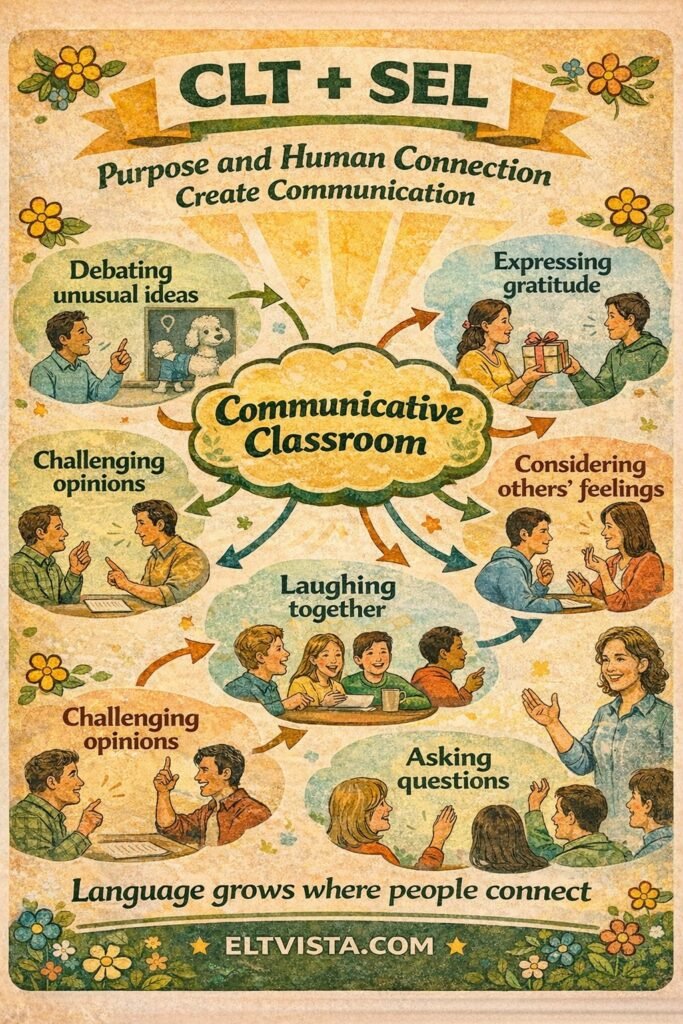
Activities like this draw on ideas that have long been associated with Communicative Language Teaching (CLT). CLT emphasizes that communication in the classroom should be purposeful. Students speak because they need to exchange ideas, solve a problem, or reach a decision together.
In the example above, students are not simply answering a discussion question. They must decide whether the party should support the law. This creates a clear communicative purpose. Learners adopt positions, defend opinions, and negotiate outcomes. Activities of this kind are often described as values clarification tasks, in which participants explore different viewpoints before reaching a conclusion.
At the same time, another important element is at work: Social Emotional Learning (SEL). SEL focuses on the emotional and interpersonal conditions that support learning. Students are more likely to participate when they feel comfortable expressing ideas, responding to others, and taking small risks with language.
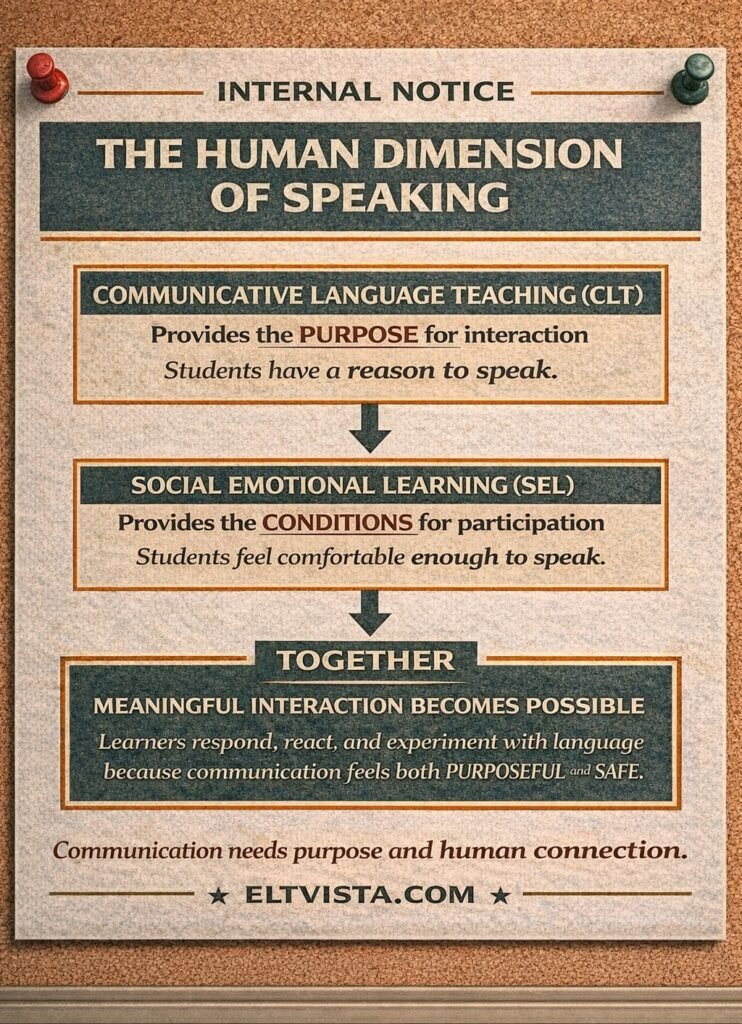
In this sense, CLT and SEL operate as a two-pronged approach. CLT provides the reason to interact; SEL supports the emotional conditions that make interaction possible.
The exaggerated nature of the dog-pants law contributes to both. Because the scenario is obviously fictional, students feel less pressure about expressing an opinion. Yet the topic still invites genuine reactions. Dog owners may immediately imagine their own pets. Others may find the proposal amusing or impractical. The discussion becomes both playful and personal.
At the same time, the teacher remains an active part of the interaction. If the discussion begins to stall—or becomes too one-sided—the teacher can step in to moderate the exchange or even provoke new perspectives by playing the devil’s advocate, modeling language along the way. The teacher, after all, is part of the classroom community and helps sustain the conditions that allow communication to develop.
Within that environment, the conversation begins to move away from correctness and toward communication. Students ask follow-up questions, clarify meaning, and react spontaneously to one another’s contributions. These are precisely the interactional behaviors that CLT has always sought to encourage.
From an SEL perspective, this kind of task also strengthens the emotional climate of the classroom. Shared humor, curiosity, and collaborative problem-solving contribute to a sense of community. Over time, that community makes it easier for learners to engage in more serious or personally meaningful discussions.
Expanding the Idea
The “dogs must wear pants” scenario is only one example of how exaggerated situations can encourage interaction. Similar tasks can take many forms.
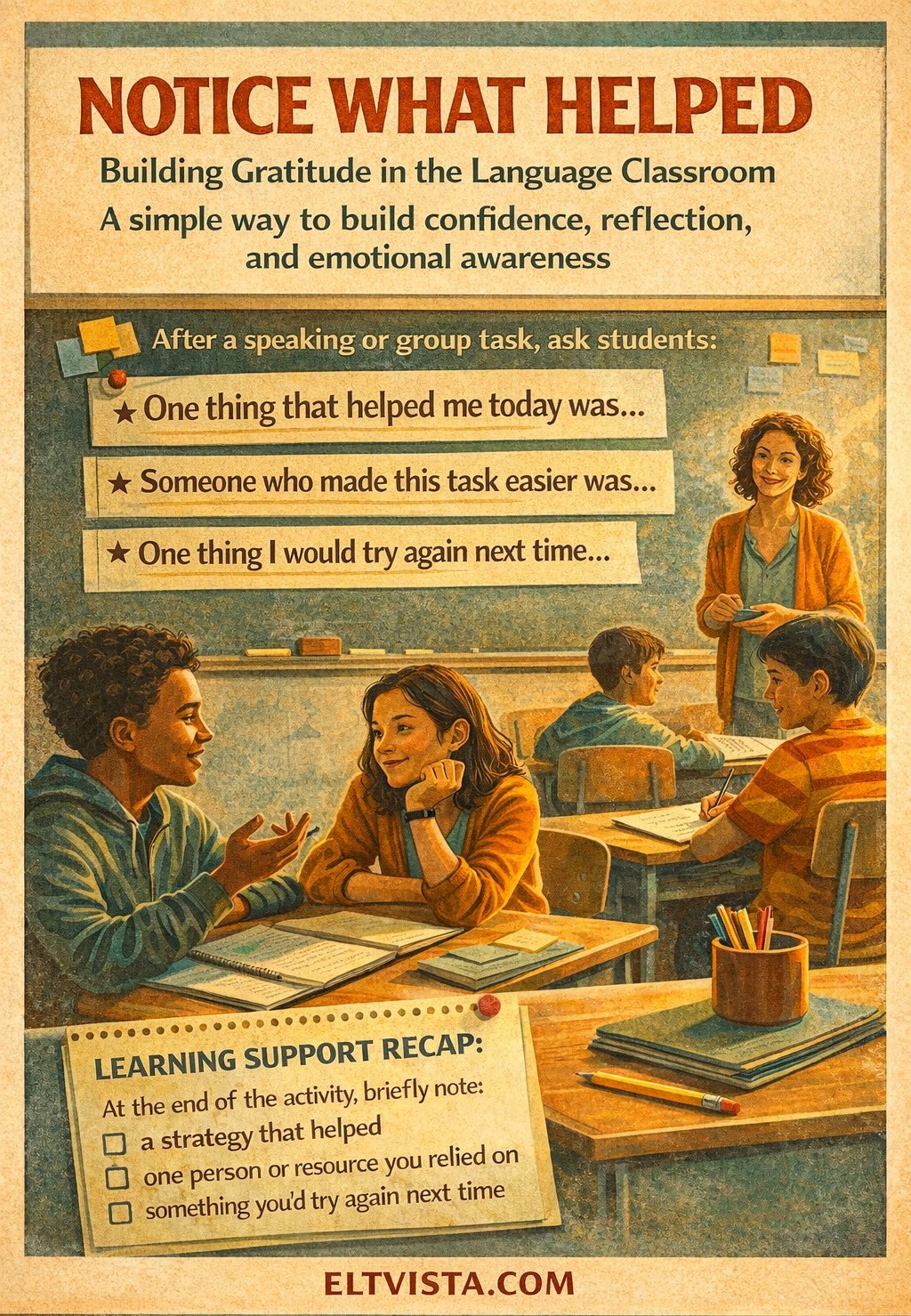
One activity sometimes used with lower-level learners involves what might be called “garbage gifts.” Students imagine receiving a gift that they clearly do not like. Their task is to respond politely and express gratitude anyway, thereby facilitating emotional awareness.
To up the ante, you can use more extreme adjectives. Students write the garbage gift on a piece of paper, for example, “Dirty Sneakers.” They then present the present and say, “Happy Birthday! This is for you!”
The partner opens the gift—most likely surprised—but must not only show gratitude, but also create something they can do with it, such as: “Thank you! How wonderful. It’s just what I needed to keep my loose coins in!”
At first glance the situation appears humorous. Yet it quickly leads to useful communicative practice. Students must decide how to express appreciation without appearing dishonest or rude. They explore language related to politeness, gratitude, and social conventions. Even younger learners can participate because the situation is easy to imagine.
Another example involves a discussion prompt such as “Sometimes it is better not to tell the truth.” Students consider situations in which a small lie might be justified. For instance, children eventually discover that Santa Claus is not real, yet many adults feel that the story serves a positive purpose. Similarly, people sometimes soften the truth in order to avoid hurting someone’s feelings—for example, when commenting on a bad haircut, untuneful singing, or an unfashionable outfit.
Here are some other suggestions:
- Candy may only be sold and eaten on Sunday.
- No more cash or coins. Only electronic payments are allowed.
- People must take a daily nap at 3 o’clock for an hour; all stores & offices must close at that time.
- All lights everywhere must be turned off daily from 11pm to 4am.
These discussions—which can easily spin off into essay and proposal writing—invite learners to reflect on their own experiences and values. Students explain reasons, challenge ideas, and compare perspectives. The topic becomes personal without becoming confrontational.
Although the scenarios differ, they share an important feature: they provide a clear reason for students to speak while allowing learners to explore ideas within a playful or exaggerated context.
Purpose, Personalization, and Interaction
What these activities have in common can be understood through the relationship between CLT and SEL.
CLT emphasizes purpose. Students communicate when they need to solve a problem, reach a decision, or justify an opinion. Tasks such as debating a law or discussing whether honesty is always necessary give learners a concrete reason to interact.
SEL contributes personalization. Learners bring their own experiences and emotions into the discussion. A dog owner may feel strongly about animal welfare. A student may recall receiving an awkward gift or telling a “white lie” to protect someone’s feelings. These connections make the conversation meaningful.
At the same time, the exaggerated nature of the scenarios creates a degree of emotional distance. Because the situations are partly fictional, students can explore ideas without feeling that they are exposing themselves too directly. The classroom becomes a shared space for experimentation rather than evaluation.

Structure Without Pressure
Another advantage of these scenarios is that they provide structure without imposing excessive pressure. Students are given a clear situation and a purpose for interaction. At the same time, the imaginative premise signals that creativity is welcome.
Teachers can further strengthen interaction by assigning roles or perspectives. In the political-party scenario, some students may support the law while others oppose it. In the garbage-gift activity, learners may practice different ways of responding politely. In discussions about honesty, students can consider multiple viewpoints before reaching conclusions.
Because the situations are easy to understand, these activities can be adapted across proficiency levels. Beginners can focus on simple opinions and basic explanations. More advanced learners can explore complex reasoning, hypothetical consequences, and persuasive arguments.
The Human Dimension of Speaking
Speaking activities are not only linguistic exercises. They are social encounters. Learners must respond to others, interpret reactions, and make themselves understood in real time.
Communicative Language Teaching provides the pedagogical framework for this interaction. Social Emotional Learning reminds us that meaningful interaction depends on an environment in which students feel comfortable participating.
Exaggerated scenarios help create that environment. They invite curiosity, humor, and shared problem-solving. Within that atmosphere, learners often feel more willing to experiment with language.
What About the Teacher?
When students hesitate to speak, teachers often try to solve the problem by increasing preparation. More vocabulary support, more structured prompts, and more guidance may seem like the obvious solutions.
However, participation sometimes improves when the nature of the task changes rather than the amount of preparation. Activities that invite imagination and playful reasoning can transform the emotional tone of interaction. The classroom becomes less about producing the correct answer and more about exploring ideas together.
For the teacher, this shift can also change the experience of the lesson itself. Instead of simply managing a discussion, the teacher begins listening with genuine curiosity. Students’ responses are no longer predictable, and the conversation can take unexpected directions. In these moments, teaching can feel less like delivering a lesson and more like participating in a shared exchange of ideas.
For many teachers, that experience is part of what makes the work meaningful. When interaction becomes lively and spontaneous, the teacher is not only facilitating communication but also rediscovering the enjoyment of being part of it.
Yet this also requires the teacher to allow themselves a certain freedom in how classroom material is used. Coursebooks can be helpful guides, but they are not sacred texts. Teachers who adapt tasks, introduce a humorous twist, or allow themselves to be slightly absurd often discover that students respond as people rather than simply as “students.”
In that sense, the question is not only what topics work in a traditional pedagogical sense, but what situations feel human, relatable, or even amusing. A strange law, an awkward gift, or a harmless social dilemma can sometimes open conversations that more serious prompts never quite reach.
Teachers might occasionally ask themselves a few simple questions:
- Would I personally enjoy answering this question?
- Does this topic invite students to respond as people rather than simply as learners completing an exercise?
- Could I adapt this prompt to make it more relatable, humorous, or surprising?
- Am I relying on the coursebook out of convenience, or because the activity genuinely invites conversation?
Sometimes a small shift in imagination—from following the task exactly as written to reshaping it slightly—can transform the emotional energy of the classroom for both students and the teacher.
A Slightly Ridiculous Path to Communication
Teachers frequently search for activities that will encourage students to speak more freely. The answer is not always found in more serious topics or more carefully structured questions.
Sometimes the shortest path to authentic communication begins with something slightly ridiculous.
A strange law.
An awkward gift.
A debate about telling the truth.
The situation may be absurd. Yet within that playful frame, learners often discover that speaking becomes easier—and far more engaging—than they expected.
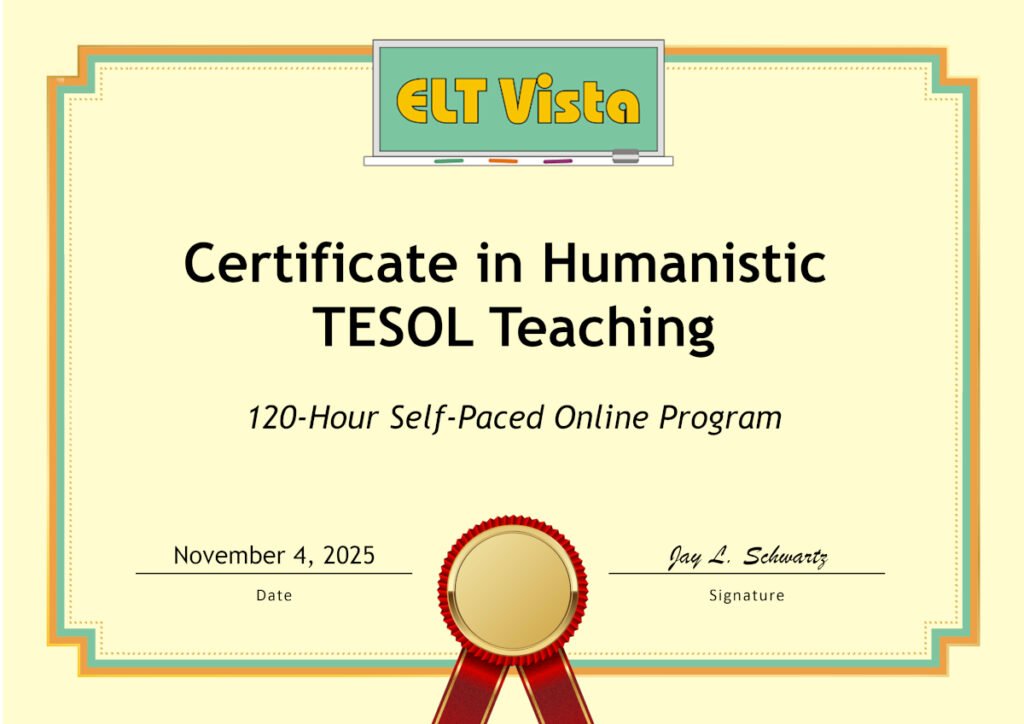
While you are contemplating your personal and profesional development, please consider our self-paced 120-hour online certificate course to your list of teaching qualifications:
For more information, click here for the ELT Vista Certificate in Humanistic TESOL Teaching. Enrollment is now open!
Also, for more articles like this one, please consider our publication, What About The Teacher?—a humanistic guide to self-actualization for TESOL teachers seeking personal and professional development. The book is available online in both digital and paperback formats at: https://www.amazon.com/dp/B0FPBWNXTZ