

Why Reliable Classrooms Rarely Look Identical
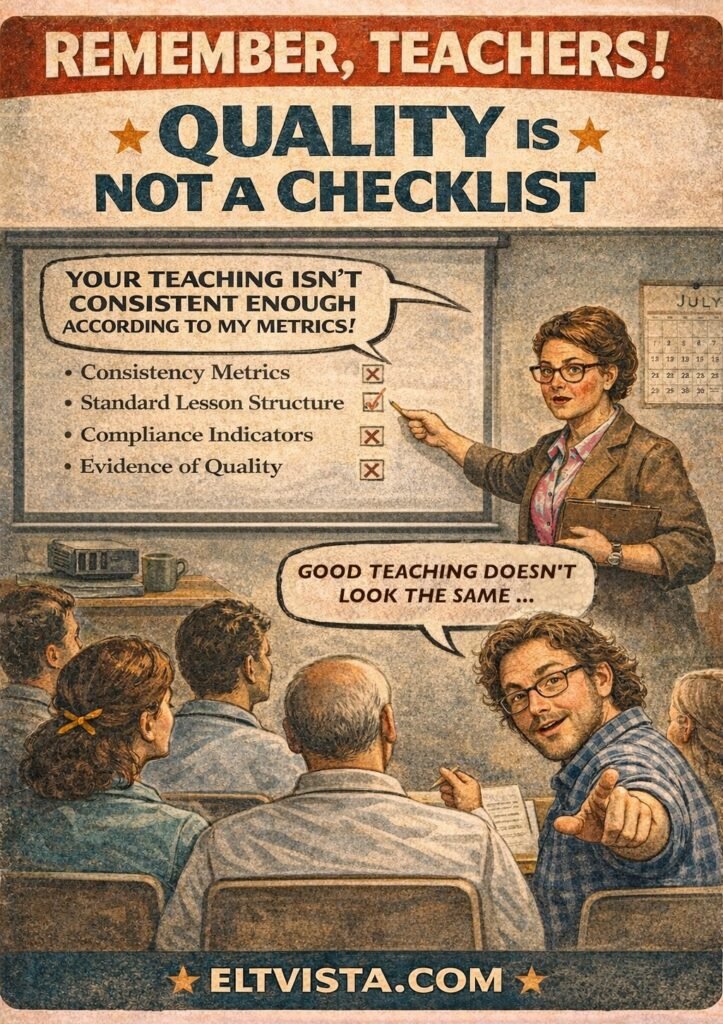
In a previous article, we explored the idea that teachers have always been engaged in quality thinking. Long before the language of audits, standards, and accreditation entered education, teachers were already reflecting on lessons, noticing patterns, and making small adjustments to improve learning over time. In other words, quality has long existed inside classroom practice under a different name: experience.
However, once the conversation shifts from quality to consistency, a new discomfort often appears. For many teachers, the word consistency feels far less comfortable than the word quality.
Why? Because beneath this discomfort sits a powerful assumption that has quietly shaped modern education: the belief that if teaching is effective, it should look consistent from one classroom to another. In other words, good teaching should be recognizable, repeatable, and visibly similar across contexts. This assumption rarely appears as a formal policy, but tends to rear its ugly head in administrative observation feedback and performance reviews. It therefore influences how quality is discussed, how teaching is observed, and how consistency is understooda—and how teaching is misunderstood.
A model built on visible sameness sits uneasily beside core humanistic principles such as individual differences, learner variability, and the teacher’s role in supporting self-actualization. The implication, even if unintended, is that effective teaching should look similar everywhere—an idea that can quietly suggest a one-size-fits-all view of classrooms.
The Uneasy Relationship with Consistency
Few educators would argue against quality in teaching. The desire to improve learning, refine practice, and support student progress is central to the profession. However, the idea of consistent teaching often produces hesitation.
This hesitation is understandable. In many educational contexts, consistency is interpreted as sameness. Teachers recognize the signs immediately: adherence to a coursebook, shared lesson templates, observation rubrics, standardized lesson staging, and expectations that lessons should look similar across classrooms. These expectations are rarely introduced as limitations. They are presented as evidence of quality.
From an institutional perspective, this logic makes sense. Schools must demonstrate that learners receive a comparable educational experience regardless of the classroom they enter. Systems seek visible indicators of reliability. As a result, consistency often becomes associated with visible uniformity rather than lived reliability.
However, classrooms are not production lines.
Consistency in Industry and Consistency in Classrooms
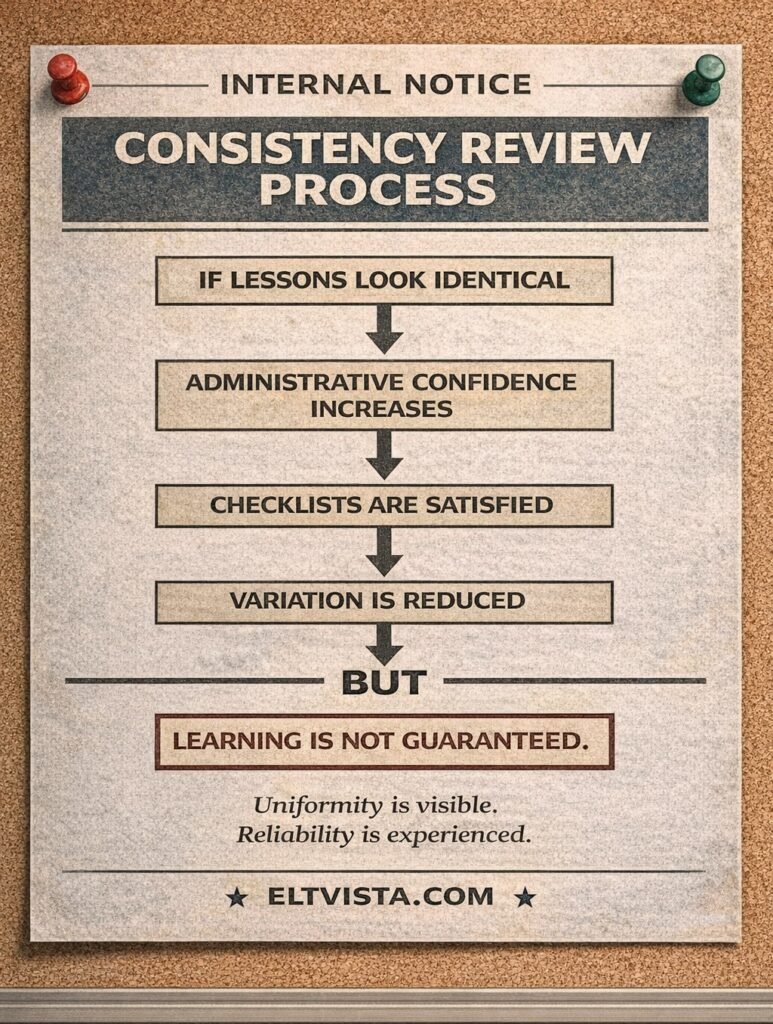
In industrial contexts, consistency often means that processes produce identical outcomes. Variation is treated as a problem to be reduced. When this logic enters education, consistency can easily become associated with uniformity: the idea that effective teaching should look the same everywhere.
Yet classrooms are human systems. Each group brings its own dynamics, histories, motivations, and challenges. Even the same group can feel different from one week to the next. Under these conditions, visible uniformity does not necessarily produce reliable learning.
This is where an important distinction emerges.
The Difference Between Uniformity and Reliability
Uniformity is visible.
Reliability is experienced.
Uniformity asks whether lessons follow the same structure.
Reliability asks whether learners know what to expect.
A reliable classroom is one in which students experience clarity, fairness, predictable routines, and emotional safety across time. Lessons may vary in content, materials, and pacing, yet the learning environment remains stable.
From a learner’s perspective, this form of consistency is deeply felt even when lessons look different on the surface.
Why Sameness Feels Like Quality
The attraction of uniformity is understandable. Sameness is, administratively speaking, easy to observe, easy to document, and easy to measure. It provides visible reassurance that standards are being maintained—regardless of where those standards stem from.
Reliability, by contrast, is harder to capture. It appears in routines, expectations, relationships, and the gradual reduction of classroom friction. These elements strongly influence learning, yet they rarely fit neatly into checklists.
This is where the language of quality begins to create confusion.
Reliability as a Form of Quality

When teachers refine routines, clarify expectations, and design smoother transitions, they are working toward reliability. They are reducing the number of variables that disrupt learning and increasing the stability of the classroom environment. That itself is indicative of organic quality management techniques.
Moreover, in other professional fields, this process would be described as quality management. In teaching, however, it is often described simply as experience.
The terminology differs. The professional intention does not. Reliable classrooms rarely look identical. Two effective teachers may run very different lessons, yet both classrooms can feel equally stable and supportive for learners.
The Practical Implication
For teachers, the practical implication is reassuring. Consistency does not require lessons to look identical. Instead, it invites teachers to focus on the repeatable foundations of classroom life: routines, expectations, clarity, and emotional safety. When these elements become reliable, lessons gain the stability needed for learning to flourish—even when activities, materials, and timing change.
What About the Teacher?
Turning Consistency into Daily Practice
If consistency is better understood as reliability rather than sameness, the practical question becomes simple: What should teachers actually do?
A useful starting point is to focus on the repeatable foundations of classroom life and refine them deliberately over time. The goal is not to standardize lessons but to stabilize the learning experience.
1. Choose one recurring classroom routine to improve.
Select a routine that appears in most lessons. Examples include giving instructions, starting the lesson, ending the lesson, managing transitions, checking understanding, or organizing pair and group work. Focus on one element only.
2. Make one small, intentional adjustment.
Decide on a specific change to test for several weeks. For example, write key instructions on the board before speaking, add an example before tasks, introduce a fixed opening routine, or set a consistent signal to gain attention.
3. Record what happens after each lesson.
Keep brief notes focused on the chosen routine. Record what improved, what still caused friction, how students responded, and whether timing became more predictable.
4. Adjust and repeat.
Refine the routine over several lessons. Keep what works and modify what does not. Continue testing the adjusted version.
5. Move to the next routine.
Once one classroom element feels more reliable, choose another. Over time, small adjustments accumulate into a stable and predictable learning environment.
This cycle mirrors reflective practice and the continuous improvement process associated with quality management: plan, try, observe, adjust, repeat. Teachers have always engaged in this process. The difference is doing it intentionally and documenting the adjustments along the way.
Looking Ahead
If teachers have long practiced quality through reflection and reliability, an important question remains. How did industrial models of quality enter education in the first place? The next article in this series will explore how ideas of standardization and measurement moved from industry into education—and what this shift has meant for teachers and learners.

While you are contemplating your personal and profesional development, please consider our self-paced 120-hour online certificate course to your list of teaching qualifications:
For more information, click here for the ELT Vista Certificate in Humanistic TESOL Teaching. Enrollment is now open!
Also, for more articles like this one, please consider our publication, What About The Teacher?—a humanistic guide to self-actualization for TESOL teachers seeking personal and professional development. The book is available online in both digital and paperback formats at: https://www.amazon.com/dp/B0FPBWNXTZ