

Getting Everyone Into the Act

Getting your students involved in the lesson has always been a challenge, regardless of the experience you have as an EFL teacher. At times, you may be fooling yourself or just a victim of wishful thinking, believing that you are doing a grand job because a couple of the kids in the class seem to be fully engaged in what you are presenting, but the rest may not be so involved. The trick is how to get everyone on board.
Being Fully on Board as the Teacher
To do this, first and foremost, you have to be fully on board, meaning that you are fully into what you are teaching. If you are enthusiastic about what you are teaching, this will surely rub off on your students too. For this to happen, you should be using content which is engaging, interesting, and relevant to both you and your students. Check to see if the themes spark your interest and those of your students, and also how well written it is. In other words, do you detect a flair in the writing style that keeps you and your students eager to read further?
If it is a listening passage, besides the content and script, are the speakers professional in a theatrical sense, since they are, in essence, actors playing a role, and an actor can make his/her character interesting and convincing by performing well. By using intriguing, quality material both in reading and listening activities in your lesson, students will be motivated and perhaps inspired, and so should you.
Why Predictable Lessons Lose Their Impact
Another way to get all your students into your lesson is by breaking routine. It is very easy, and in many ways natural, to get into a set routine when conducting lessons. It may begin by taking up set homework, giving back written homework, and then continuing where you left off in the course book. All these activities have their purpose; however, when it becomes the only thing you do besides giving tests, it becomes tedious and not what students deserve.
Breaking up this routine, doing something different, will wake up students, but not something which is different for the sake of being different, but rather something which is slightly unorthodox but still educational and of benefit to the student’s learning process. When you begin teaching in this way, when students realise that the following lesson procedure will not be a carbon copy of the previous one, that lessons may be somewhat unpredictable, then students will become more alert and consequently more productive.
Activities That Bring Everyone into the Act
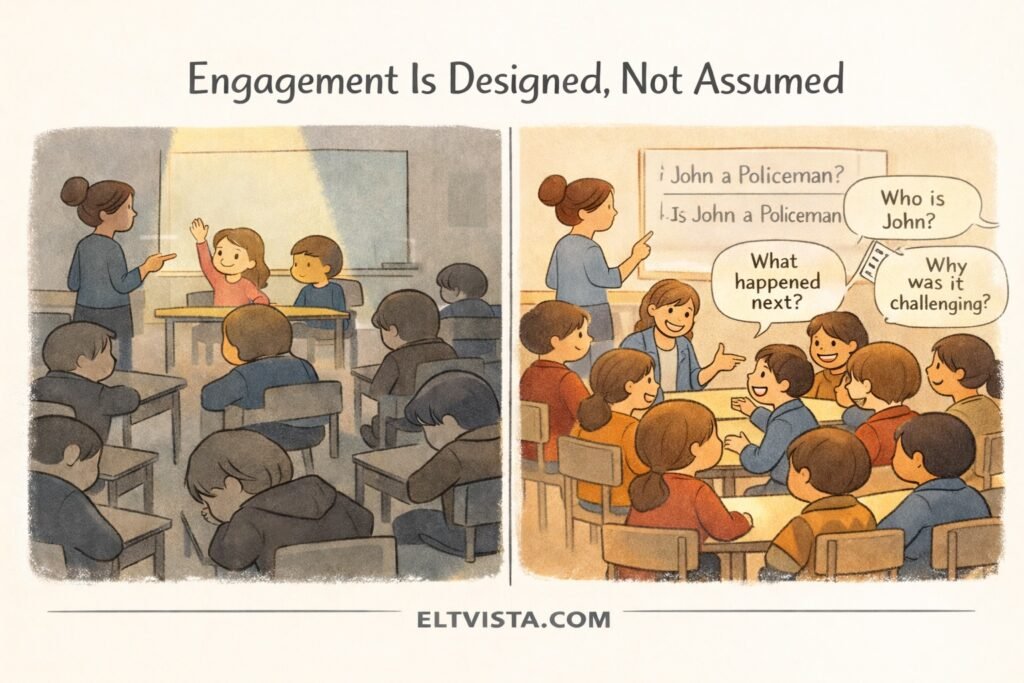
One example of this is an activity that I have used to good effect which involves writing stories for B2 students and higher. In the set course book, students may be asked to write a story which continues from a given opening sentence, for example, “John knew it was going to be a challenging day.” Instead of simply setting this as homework, this can be changed, with the teacher telling the class he/she knows what the storyline is and the students have to ask yes-or-no questions to determine what happens in the story.
What the students don’t know is that the teacher doesn’t know what the storyline is, and the students will create it based on the questions they ask. For instance, the teacher may ask, “Who is John? What does he do?” and answer yes to every third question or at random. The first student may ask, “Is John a schoolboy?” Teacher: “No.” Second student: “Is John a teacher?” Third student: “Is John a policeman?” Teacher: “Yes.”
Then, given that question, the teacher asks other questions such as, “What did the policeman find challenging? What was going on?” so that the story is fleshed out. The benefit of this activity is that it involves all the students; the construction of the storyline is a collective effort—without the students fully realising that it is. It is spontaneous creation and unpredictable, since no one, including you, the teacher, will know how it turns out. After the storyline has been created, you set it for written homework.
Another activity that can involve and engage the entire class is one I call “Liar.” In this activity, the teacher asks the students to write a short passage (a few sentences) about something they either saw or did that they thought was either very interesting or strange. The teacher also tells them that this event must be something they haven’t told anyone in the class about before but are willing to share now.
The teacher later gathers these accounts, filters them for appropriateness, and asks three students (including the one who wrote it) to read it and imagine that they are the ones who experienced it and try to convince the class they are the one. Next, the teacher reads the account to the class and says one of the three said this, and the class asks questions so as to determine who has given the most convincing account. It is a good activity to use when you’re practising the use of the question form, as well as speaking practice for coming up with spontaneous explanations.
While you are contemplating your personal and profesional development, please consider our self-paced 120-hour online certificate course to your list of teaching qualifications:
For more information, click here for the ELT Vista Certificate in Humanistic TESOL Teaching. Enrollment is now open with a special Holiday Launch promotion!✨