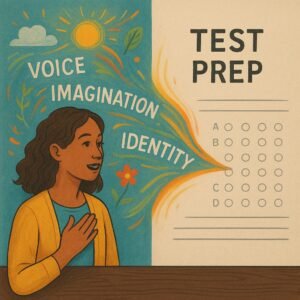
The ghosts of standardized tests are alive and well in classrooms across the world—haunting lesson plans, shaping curricular goals, and quietly dictating teacher behavior. In many TESOL settings, the pressure to produce measurable results has all but relegated creativity to the back row—tolerated when there’s time, celebrated when it decorates a classroom wall, but rarely treated as central to language learning.
Yet here’s the truth: creativity isn’t extra. It’s elemental. It is the oxygen of a humanistic classroom, essential to teacher fulfillment and learner development.
When Creativity Becomes Compliance
In the age of AI writing tools, performance metrics, and “learning outcomes,” creativity is often framed as something we manage or add in—as if learners must first master the “real stuff” before they can afford to color outside the lines.
Creativity in education, we are told, is the driving force that transforms learning from passive absorption into active exploration. It encourages students to think critically, question assumptions, and generate original ideas by connecting knowledge across disciplines. Through creative pedagogy, teachers foster curiosity, adaptability, and problem-solving skills that prepare learners for complex, unpredictable futures.
Unfortunately, this creativity often ends up fenced in by the standardized, the measurable, and the safe. We treat creativity as an “activity” when in fact it is a disposition, an orientation that brings the whole person—imagination, emotion, intuition—into the learning space.
From Outcomes to Becoming
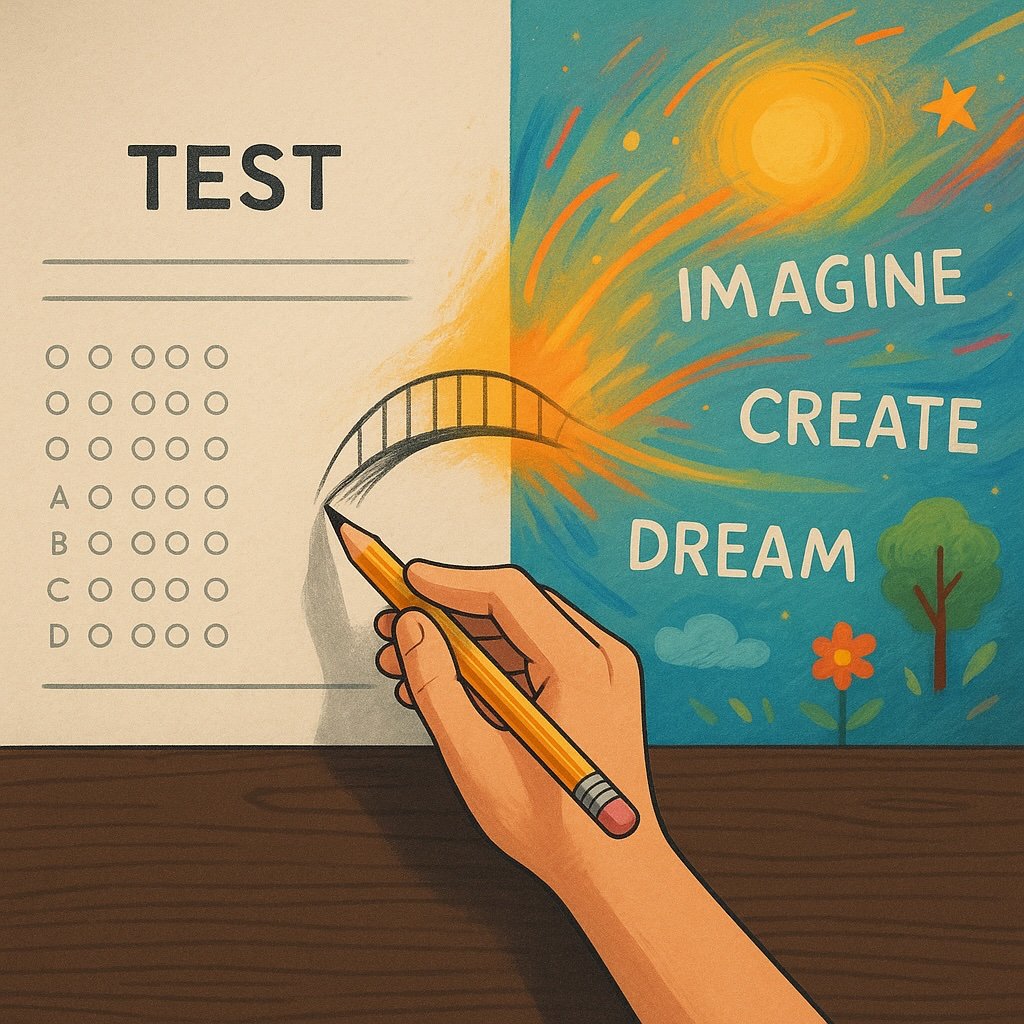
In a humanistic classroom, creativity is not ornamental; it is foundational. It allows us to teach from a place of authenticity rather than compliance. It grants learners the freedom to explore who they are becoming—not just what they know. More importantly, creativity awakens the ability to see possibility where others see limitation, to reframe challenges as invitations, and to make meaning beyond measurement.
Creativity isn’t something we add to language teaching. Language itself is creative. Every sentence a learner forms is an act of risk, invention, and personal expression. Yet when teaching becomes reduced to test-prep, we dull the very capacities we claim to nurture: curiosity, voice, identity.
A Humanistic Reframe of Testing
This is not a call to banish testing. Assessment has its place—but not at the expense of the human element. A humanistic approach to assessment might ask:
- Does this test honor the learner’s voice?
- Does it reflect real use of language, or mere performance of form?
- Does it invite expression, or demand compliance?
Creativity, then, becomes less about decorating the syllabus and more about re-humanizing it.
Three Humanistic Truths About Creativity in TESOL
- Creativity is how we humanize the syllabus.
It turns “Unit 5: Modal Verbs” into “How to Build a World You Want to Live In.” - Creative teaching is not fluffy; it is rigorous in a human sense.
It demands presence, adaptability, and the courage to improvise in real time. - A creative teacher models a self-actualized adult.
Students don’t just acquire language; they witness what it looks like to live curiously, critically, and consciously.
What About the Teacher? (Reflective Task)
Think back to your last lesson. Where did creativity show up—in your choices, your students’ ideas, or in the space between?
- Did you invite self-expression or simply follow the plan?
- When did you feel most alive as a teacher—and how might you bring more of that into your practice?
- What would you do differently if the test were not the horizon of your work?
Your self-actualization matters. The classroom reflects not just what you teach, but who you are becoming.
For more articles like this, please consider our publication, What About The Teacher?—the main text upon which the our online certificate course in humanistic TESOL teaching is based. The book is available online in both digital and paperback formats at: https://www.amazon.com/dp/B0FPBWNXTZ
✨ While you are contemplating your personal and profesional development, as well as your New Year’s resolutions, please consider adding our self-paced 120-hour online certificate course to your list: For more information, click here for the ELT Vista Certificate in Humanistic TESOL Teaching. Enrollment Is Open Now with a special! Holiday Launch promotion! ✨