
The following are articles relating to our mission of facilitating the personal and profesional development of educators, as well as humanistic teaching practices.
- From Quality to Consistency—Where the Meaning Changed
 A model built on visible sameness sits uneasily beside core humanistic principles such as individual differences, learner variability, and the teacher’s role in supporting self-actualization. The implication, even if unintended, is that effective teaching should look similar everywhere—an idea that can quietly suggest a one-size-fits-all view of classrooms.
 - The Classroom Is Already a System
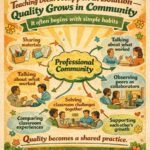 The phrase quality management rarely excites classroom teachers. For many, it conjures images of accreditation visits, institutional audits, observation rubrics, and administrative paperwork. It sounds managerial, corporate, and distant from the daily realities of teaching.
 - Teaching Beyond Inherited Systems
 Old habits rarely survive because they are effective. More often, they survive because they are familiar. Complacency disguised as tradition. Equilibrium mistaken for progress. One-size-fits-all as professional comfort.
 - When “Pay Attention” Isn’t Enough: Teacher Language, Presence, and the Humanistic Classroom
 Decades ago, child psychologist and educator Haim Ginott offered a perspective that feels remarkably contemporary. His work on classroom communication suggested that the teacher’s language does far more than manage behavior; it establishes the emotional architecture in which learning either expands or contracts. Ginott encouraged what he called congruent communication; it is professional language that preserves student dignity while guiding the classroom toward purpose.
 - SEL, Emotional Intelligence, and Gratitude: A Practical View from the Language Classroom
 In the language classroom, gratitude is not about politeness or forced positivity. It is about attention—the ability to notice what supported learning while it was happening, rather than only what fell short afterward.
 - Humanism Without Distance: What MLK Still Asks of Teachers
 Every year we quote Martin Luther King Jr. Every year we praise his moral clarity, his courage, his vision of justice and dignity. At the same time, teachers are told to “be humanistic,” “be learner-centered,” and “support the whole learner” while working under conditions that quietly make dignity harder, not easier, to sustain.
 - Getting Everyone Into the Act
 Getting your students involved in the lesson has always been a challenge, regardless of the experience you have as an EFL teacher. At times, you may be fooling yourself or just a victim of wishful thinking, believing that you are doing a grand job because a couple of the kids in the class seem to be fully engaged in what you are presenting, but the rest may not be so involved. The trick is how to get everyone on board.
 - Open Communication, Empathy, and Difficult Conversations
 In many classrooms, teachers avoid topics like climate change because they fear conflict or discomfort. Yet avoiding difficult topics does not teach students how to communicate about them—it simply postpones the problem.
 - Grades, Judgment, and the Machinery of Worth
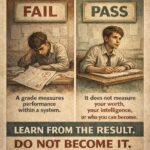 What’s happening in classrooms mirrors something much older and much broader than schooling. Grades are only one visible cog in a larger mechanism—one that long predates formal education. It is the machinery of deference, legitimacy, and external authorization.
 - Of Resolutions, Humbug, and Community—A Reflective Riff on Scrooge
 Long before resolutions became annual rituals, Charles Dickens, the nineteenth-century English novelist and social critic, offered a rather effective alternative. In A Christmas Carol, Scrooge does not sit down and draft a list of behavioural targets or learning outcomes. He is shown his life—where it came from, how it currently unfolds, and where it is heading if nothing changes.
 - Protecting or Infantilizing? Rethinking Blanket Bans, Digital Literacy, and the Role of Education
 “The pattern is familiar: we fear the tool instead of investing in the skills that would make its use healthy and meaningful. Moreover, when we focus solely on removing access, we risk suppressing expression rather than equipping children to navigate a digital world they will inevitably inherit. “
 - Teaching in the Age of Angst: Erich Fromm, Self-Actualization, and the Teacher-Self in TESOL
 Fromm believed the great paradox of modern life was this: people crave freedom, yet fear the responsibility that freedom demands. In response, they retreat—into systems, hierarchies, labels, and roles that offer security at the cost of authenticity. TESOL teachers know this tension intimately.
 - Creativity Is Not a Strategy—It’s a Birthright: Reclaiming the Human Side of Teaching in a Testing Culture
 In humanistic teaching, creativity is foundational because language itself is creative. Every sentence a learner forms is an act of risk-taking and self-expression. When instruction becomes reduced to test preparation, we mute the very capacities we claim to nurture: voice, imagination, identity.
 - Taking Responsibility—Because Education Isn’t Just What You Teach, It’s How You Live
 Yes, in many places, climate change has already moved into the neighborhood. And as teachers, as materials developers, it means something to stand in front of a classroom built on land that is slowly, visibly, and measurably disappearing. To treat climate awareness as just another thematic unit between “Shopping” and “Sports” is not only poor pedagogy—it is a dereliction of responsibility.
 - The Parallels Between Dewey’s Educational Philosophy and Dadaism: A Reflection on Self-Actualization in TESOL
 A reflection on how John Dewey’s experiential learning philosophy and the Dada movement’s creative rebellion inform humanistic, self-actualizing approaches to TESOL and Dogme ELT.
 - When People Show You Who They Are: Lessons in Leadership, Crisis, and Self-Actualization
 Maya Angelou once said, “When someone shows you who they are, believe them the first time.” Those words, simple and graceful as they sound, have extraordinary weight in professional life—especially in education, where trust, empathy, and perception form the unseen scaffolding of every classroom and workplace.
For more articles like these, please consider our publication, What About The Teacher?, available online in both digital and paperbackformts at: https://www.amazon.com/dp/B0FPBWNXTZ