Earth Day, the Anthropocene, and the Language Classroom:
Bringing Environmental Responsibility into the Conversation
Each year Earth Day encourages reflection on the condition of the planet we share—and what we have done to it. In recent decades, scientists and historians have increasingly used the term Anthropocene to describe our present moment, a proposed geological era in which human activity has become a dominant force shaping the Earth’s climate, oceans, and ecosystems more so for the worse.
The idea is unsettling.
For most of human history, nature molded civilization. Yet today, civilization increasingly deforms nature. Forests disappear in decades rather than in centuries. Glaciers that took thousands of years to form are melting within a generation. Oceans that once seemed vast enough to absorb anything are now showing unmistakable signs of stress, as well as our refuse.
Consider the cruise industry alone. These floating cities carry thousands of passengers through some of the world’s most fragile marine environments. Yet investigations have repeatedly shown that cruise ships discharge waste streams ranging from untreated sewage to chemical runoff into the very waters their passengers come to admire. In many cases the scale of these discharges would be illegal on land.
For students, however, these issues often remain distant abstractions. Climate change appears in headlines and documentaries, but it rarely enters the classroom as a space for meaningful conversation.
The language classroom, however, is uniquely positioned to change that.
Language learning is not only about vocabulary and grammar. It is about expressing ideas, negotiating meaning, and exploring perspectives. When environmental topics are approached thoughtfully, they can transform language practice into something far more meaningful: a conversation about our relationship with the world itself.
However, this requires more than simply assigning a reading on climate change.
Students tend not to become engaged when they are asked to repeat familiar talking points. What often works better is to shift the perspective entirely—to move from discussing environmental problems to speaking from within them, personalizing things if you will.
This is where three complementary approaches come together: Communicative Language Teaching (CLT), Social Emotional Learning (SEL), and psycholinguistic dramaturgy (PLD).
CLT: Giving Language a Purpose
Communicative Language Teaching emphasizes the importance of purposeful interaction. Students speak more freely when language is connected to meaningful ideas rather than isolated drills.
Environmental topics provide precisely this kind of communicative purpose. They invite debate, speculation, explanation, and persuasion. Students must articulate opinions, challenge assumptions, and negotiate meaning with others.
However, communication alone is not enough.
SEL: Creating the Conditions for Meaningful Dialogue
Social Emotional Learning focuses on the emotional conditions that allow communication to flourish. Students must feel comfortable expressing opinions, listening to others, and considering perspectives that may differ from their own.
Environmental issues often involve ethical questions: responsibility, fairness, and long-term consequences. When handled thoughtfully, these conversations can strengthen empathy and critical reflection rather than simply producing arguments.
This is where the third element becomes especially powerful.
PLD: When Language Emerges Through Role and Perspective
Psycholinguistic dramaturgy invites students to speak from roles that reshape how they think and communicate. Instead of speaking only as themselves, learners adopt identities that require imagination and perspective-taking.
When students speak as a character, a witness, or even an element of the natural world, language becomes more expressive. Learners experiment with tone, emotion, and rhetorical style. Communication becomes less mechanical and more exploratory.
In the context of Earth Day, this approach allows students to do something unusual: to imagine what the planet might say if it could answer us.
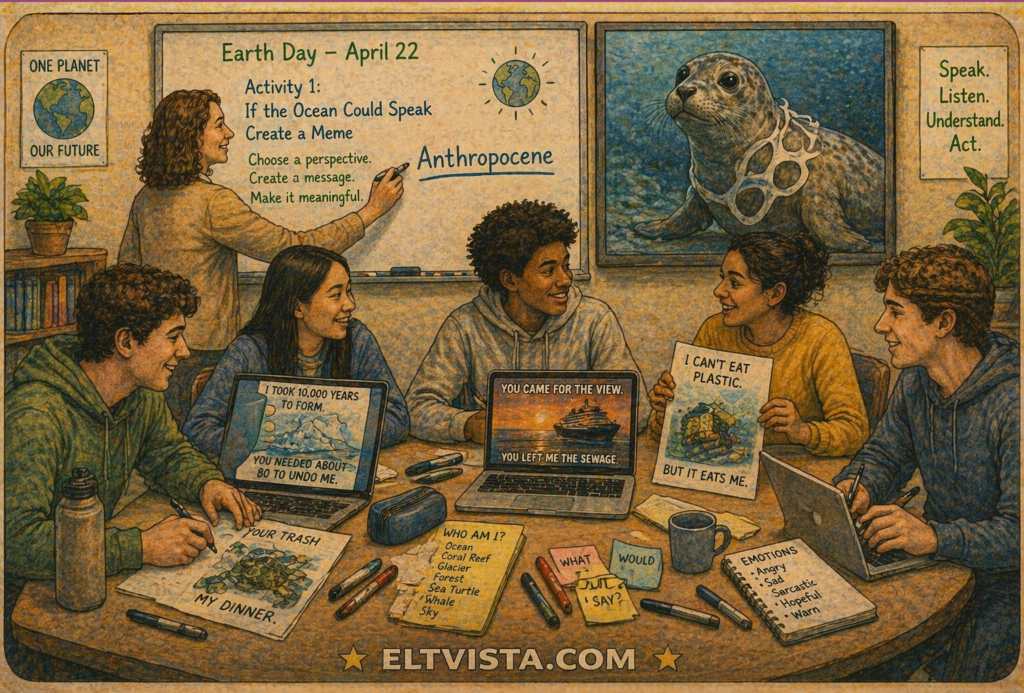
Activity 1: “If the Ocean Could Speak”
— Environmental Meme Creation
Students imagine they are a part of the natural world affected by human activity.
Possible identities include:
- the ocean
- a coral reef
- a melting glacier
- a forest
- a sea turtle
- the sky over a polluted city
- a whale migrating through shipping lanes
Students then create a meme from that perspective.
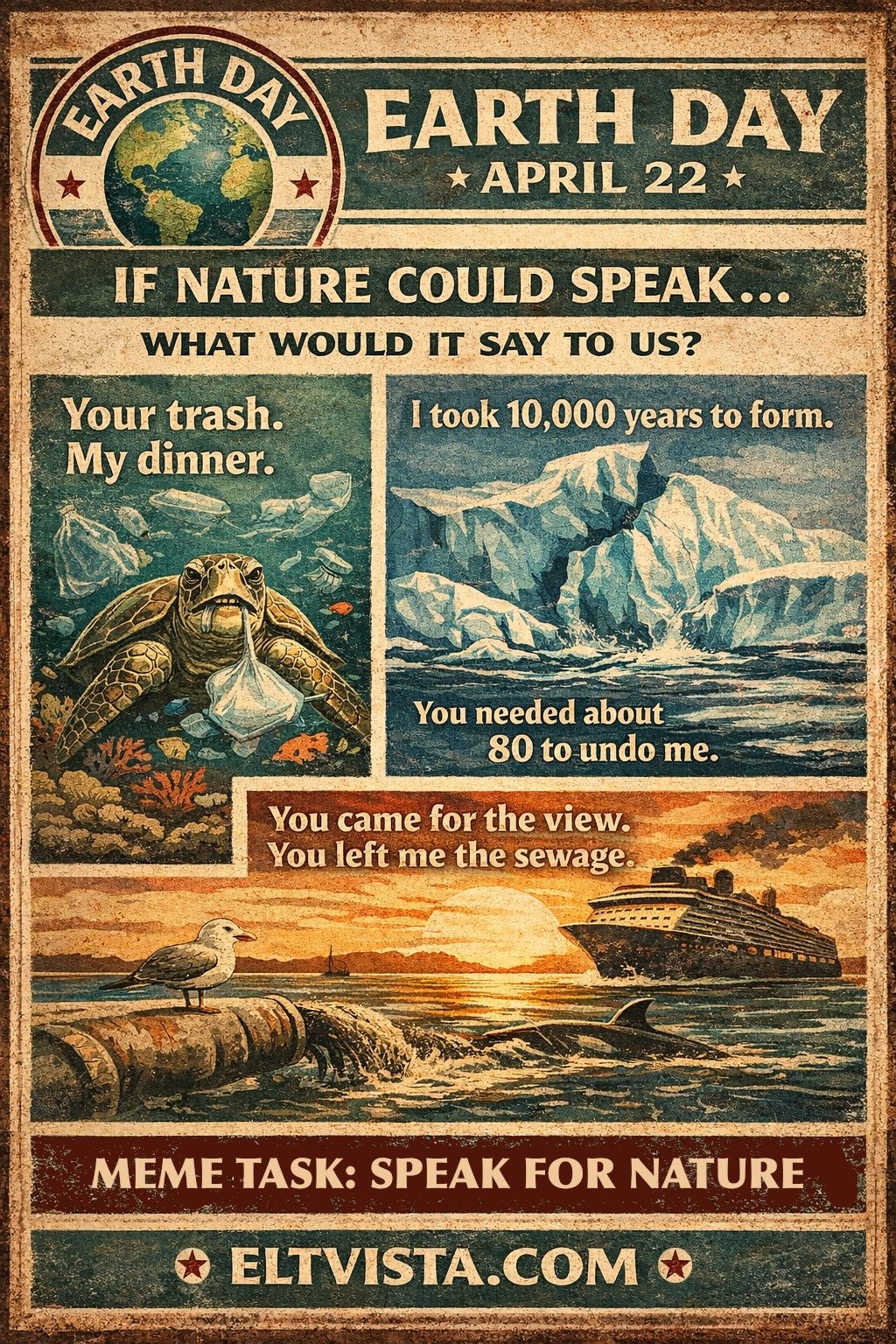
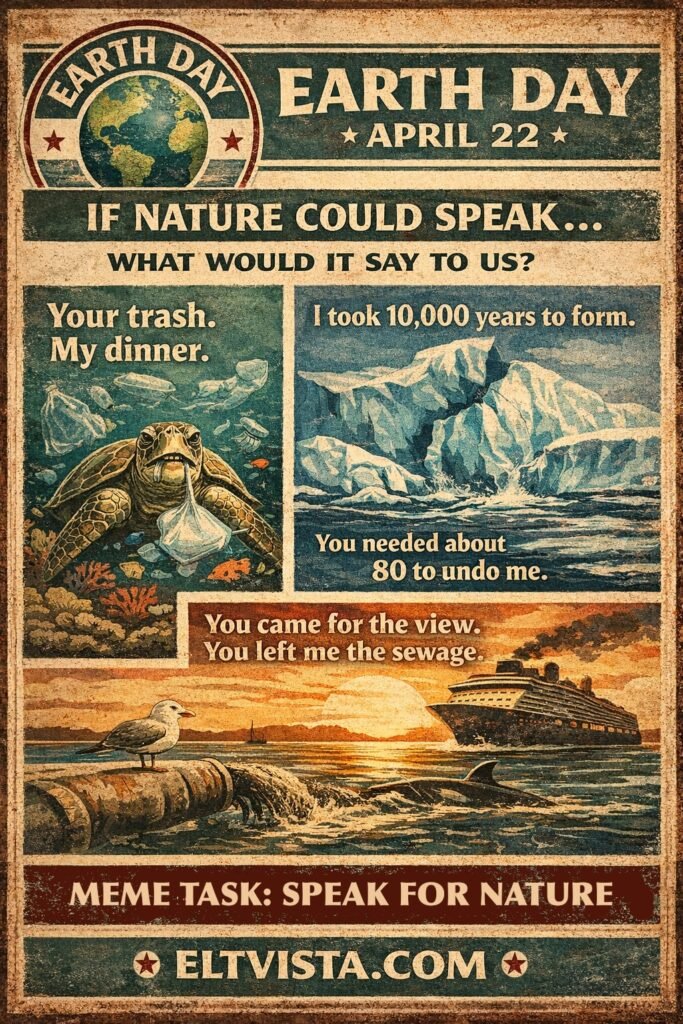
Examples:
Image: a sea turtle surrounded by floating plastic
Caption: “Your trash. My dinner.”
Image: a melting glacier
Caption: “I took 10,000 years to form. You needed about 80 to undo me.”
Image: the ocean at sunset with a cruise ship in the distance
Caption: “You came for the view. You left me the sewage.”
Students present their meme to the class and explain:
- Who they are speaking as
- What message the meme communicates
- What emotion they want viewers to feel
This activity combines creative expression, explanation, and persuasive language.
Activity 2: The Trial of Humanity
This activity transforms the classroom into a dramatic communicative event.
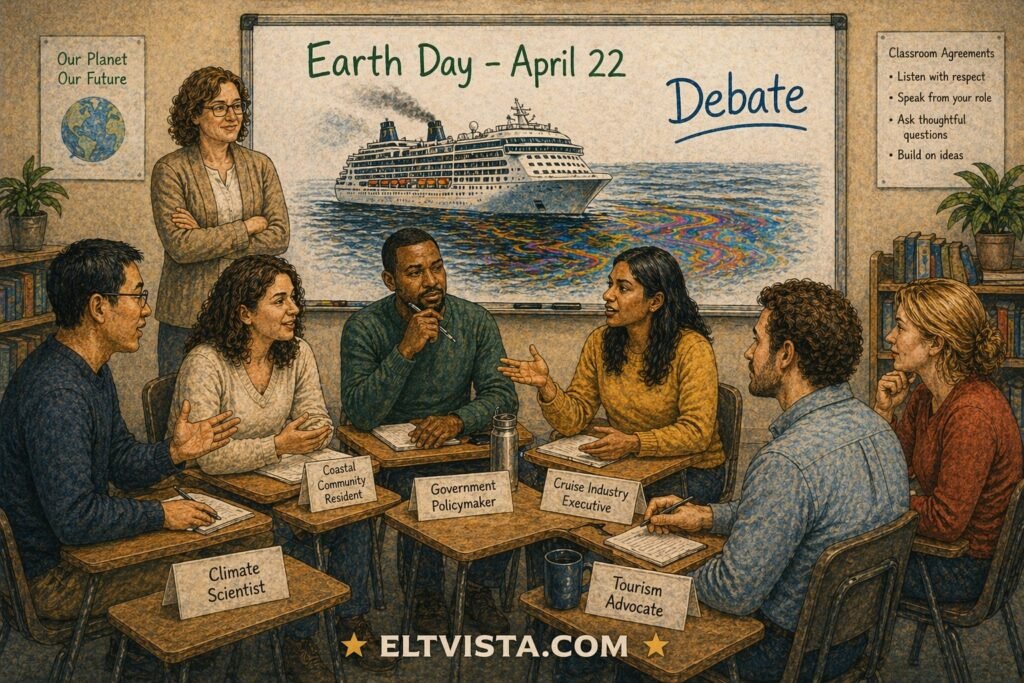
Humanity is placed on trial. Students take on roles such as:
Nature’s witnesses
- The Ocean
- A Coral Reef
- The Arctic Ice
- A Rainforest
- A Migrating Whale
Human roles
- A cruise industry executive
- A climate scientist
- A government policymaker
- A tourism advocate
- A coastal community resident
Each participant must speak from the perspective of their role.
Examples:
The Ocean:
“For centuries I carried your ships. Now I carry your waste.”
The Coral Reef:
“You come to photograph my beauty—but your warming seas bleach my color away.”
The Cruise Executive:
“Millions of people experience the beauty of the oceans through our ships. Tourism creates jobs and livelihoods across the world.”
Students question each other, defend positions, and respond to arguments.
The goal is not to determine a winner. The goal is to generate authentic communicative interaction.
When Language Meets Responsibility
When students engage with real issues, communication becomes more authentic. They are no longer speaking merely to complete an exercise. They are speaking to express ideas, test arguments, and imagine perspectives beyond their own.
Earth Day activities in the language classroom therefore serve a dual purpose. They raise awareness about environmental challenges while also reminding learners that language is a tool for participating in the conversations that shape our shared future.
And perhaps that is the quiet strength of the language classroom.
It is one of the few places where communication, imagination, and human connection can come together—sometimes allowing voices to be heard that the world itself cannot easily express.
What About the Teacher?
At this point, the question inevitably returns to the teacher.
If Earth Day activities encourage students to think about responsibility toward the planet, it is also reasonable to ask whether teachers themselves have a role in shaping that awareness. After all, classrooms do not operate in a vacuum. The topics that enter a lesson, the perspectives that are explored, and the questions that are raised are often introduced by the teacher in the first place.
Students rarely arrive prepared to initiate conversations about complex global issues on their own. They may have opinions, concerns, or fragments of information, yet the classroom context in which those ideas become communicative tasks usually begins with the teacher. In that sense, the teacher does more than organize language practice. The teacher frames the conversation.
This carries a certain responsibility.
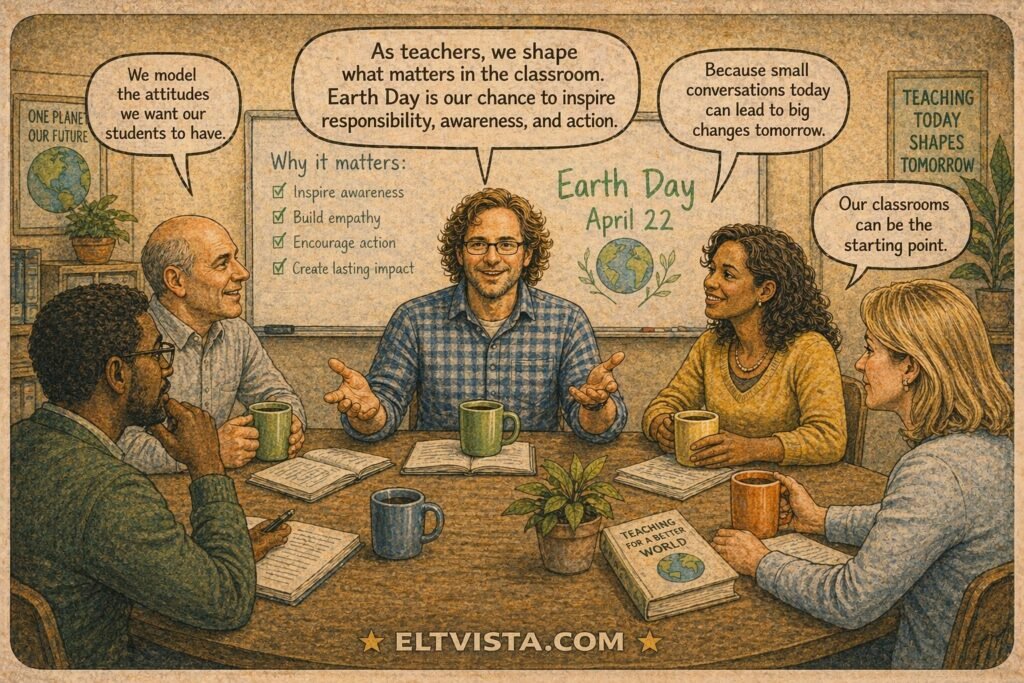
Language teachers frequently emphasize the importance of modeling language clearly and accurately. Learners listen to how teachers express ideas, how they organize arguments, and how they respond to differing viewpoints. Yet the same principle applies beyond grammar and vocabulary. Teachers also model attitudes toward inquiry, reflection, and responsibility.
Introducing environmental topics into the classroom therefore raises an important question for teachers themselves: what assumptions do we bring with us when we frame these discussions?
Responsible teaching does not require imposing personal beliefs or prescribing conclusions. Rather, it involves creating space for thoughtful engagement. It means presenting issues with enough context for students to consider them seriously, encouraging respectful dialogue, and remaining open to the range of perspectives that learners may express.
In this sense, the teacher’s role is not to deliver answers but to cultivate awareness.
When teachers introduce meaningful contexts for communication, students often respond with curiosity, creativity, and thoughtful reflection. The classroom becomes more than a place where language is practiced. It becomes a space where learners develop the confidence to speak about issues that matter to them.
And perhaps this returns us once again to the broader purpose of education.
If language allows people to participate in conversations about the world they inhabit, then helping students engage with those conversations responsibly may be one of the most important forms of modeling a teacher can offer.
While you are contemplating your personal and profesional development, please consider our self-paced 120-hour online certificate course to your list of teaching qualifications:
For more information, click here for the ELT Vista Certificate in Humanistic TESOL Teaching. Enrollment is now open!
Also, for more articles like this one, please consider our publication, What About The Teacher?—a humanistic guide to self-actualization for TESOL teachers seeking personal and professional development. The book is available online in both digital and paperback formats at: https://www.amazon.com/dp/B0FPBWNXTZ