
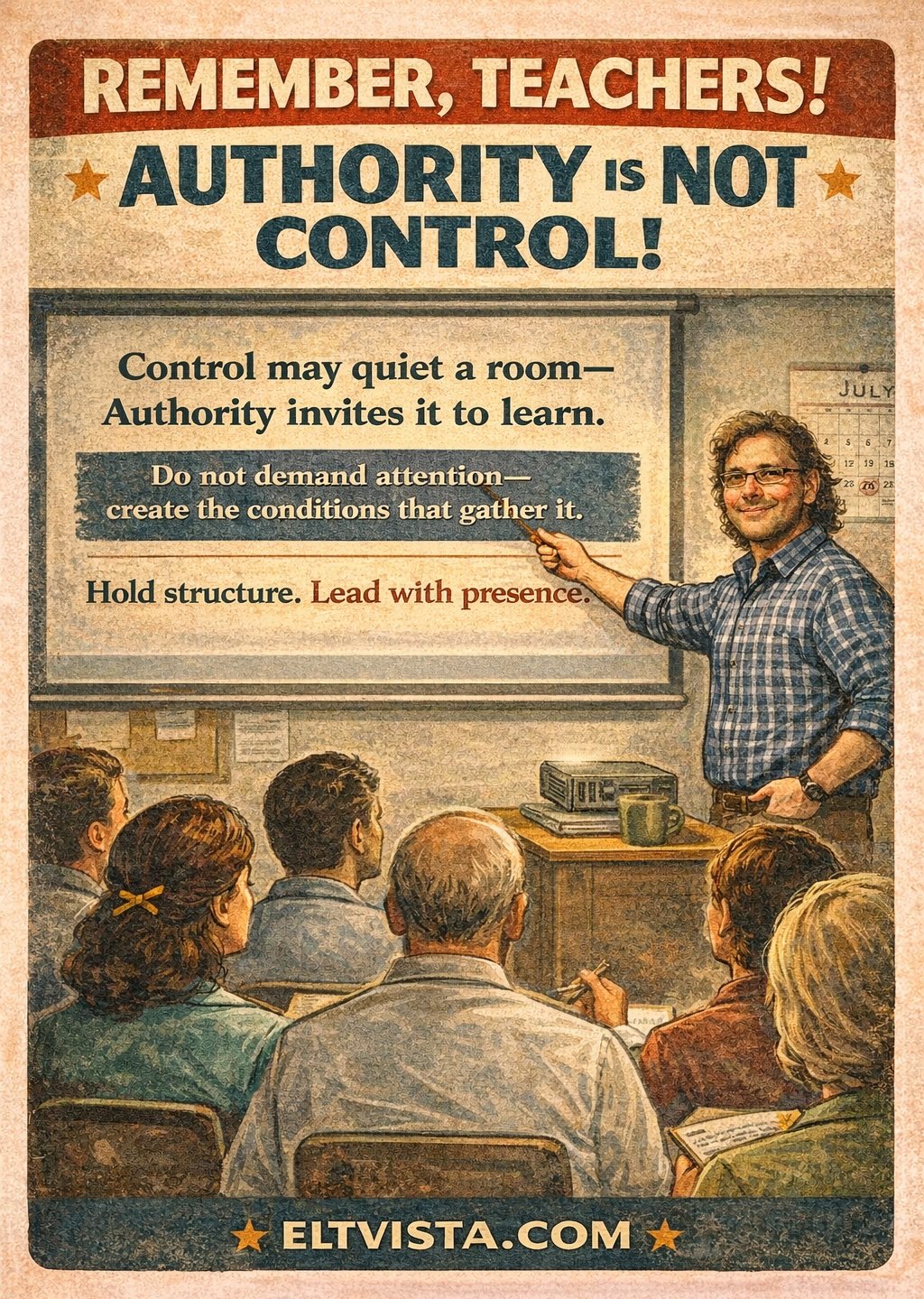
You are about to enter another dimension—not only of sight and sound, but of mind. A place where expectation meets interruption. Next stop: the classroom.
You are already in the middle of the lesson. The grammar point is unfolding exactly as planned. Examples sit on the board. Your explanation is measured and clear. Yet the room is drifting. You sense the disconnect and wandering eyes.
A glow from handheld screens. Fingers scrolling. A backpack unzipped. Someone whispering. Eyes moving everywhere except toward you. A bag of potato chips is opened.
Tensely, you pause, allowing the moment to correct itself, but it does not. You reach, almost instinctively, for imperative speech—the professional language of control many teachers have been conditioned to trust.
“Pay attention!”
Your intention is entirely sound. You want to teach. You want the class with you. You want your preparation —and your professionalism—to matter. You want respect. You demand respect. You are the authority.
The words land. The room quiets, at least on the surface. And yet, you sense that something still is missing. Students may comply, yet they are not fully present.
And you feel the added tension immediately, because beneath imperative speech lies something deeply human: the desire to be taken seriously and to know that your voice carries weight.
So it is worth asking, if only for a moment:
What are you hoping to do with the attention you are demanding? To move through the explanation? To secure the grammar point? Ensure the lesson proceeds as intended?
After all, learning does not occur simply because a room grows quiet. Students can obey an imperative without ever entering the thinking. Perhaps, then, the deeper question is not whether students are paying attention. Perhaps it is what makes attention possible in the first place.