
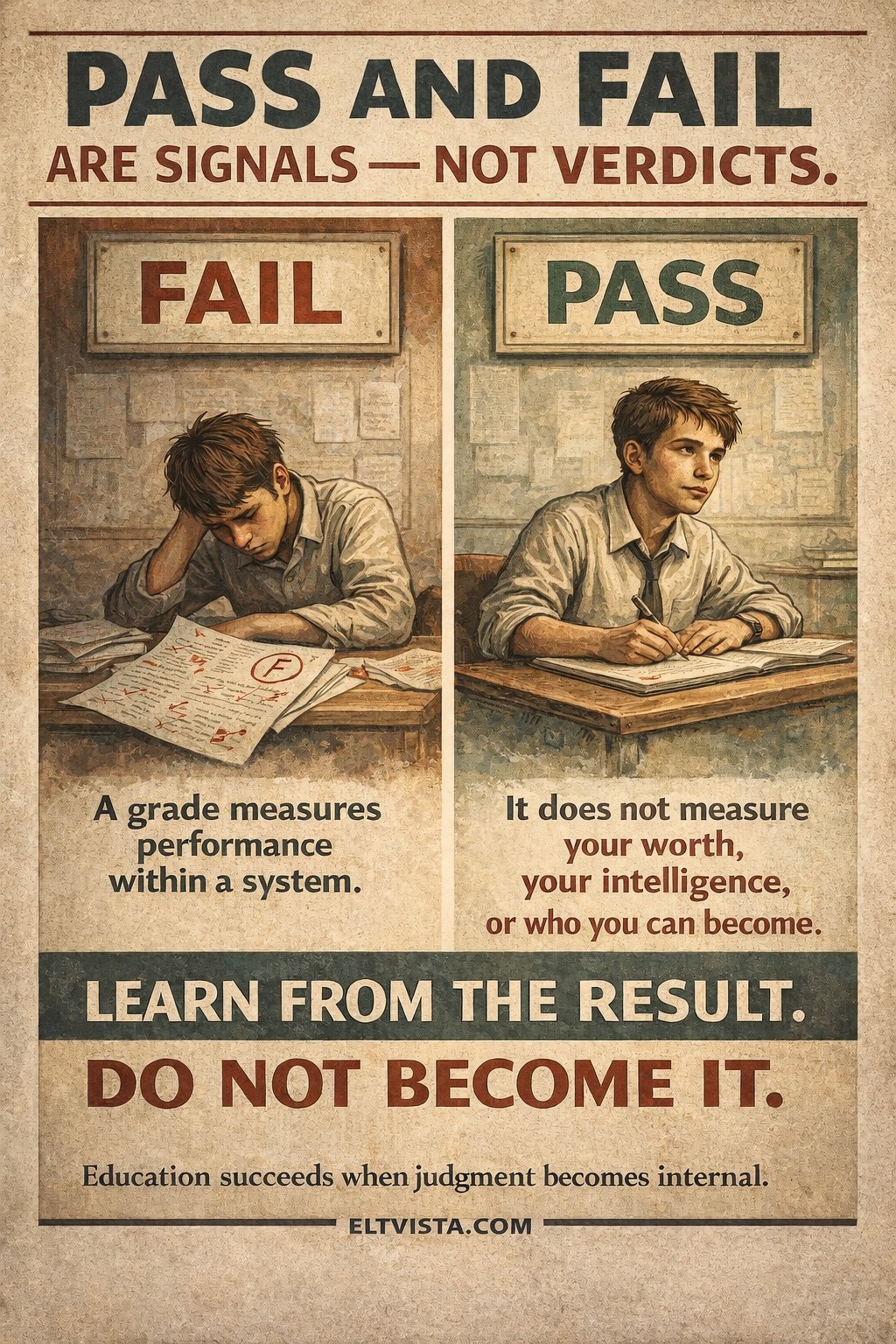
Grades, Judgment, and the Machinery of Worth
Nobody ever tells students the most dangerous thing about grades:
they don’t just measure performance—they train you to outsource your sense of worth.
They feel neutral and necessary. That’s exactly why they’re dangerous.
Grading is a necessary evil in education. Necessary, because institutions require some way to sort, credential, and move people through systems at scale. Evil—not in a melodramatic sense, but in a quiet, corrosive one—because grades are so easily mistaken for something they are not.
A grade is information. It is a signal within a bounded system. It is not a measure of human worth, potential, or legitimacy. Most students are never explicitly told this, which is why the signal so easily becomes a verdict. Unless that caveat is made explicit, students absorb something far more dangerous than the grade itself: the idea that judgment arrives from elsewhere, and that its verdict is final.
This is where the real injustice begins. Not because the system is intentionally cruel, but because it is largely silent about what its judgments are meant to mean—and what they are not.