
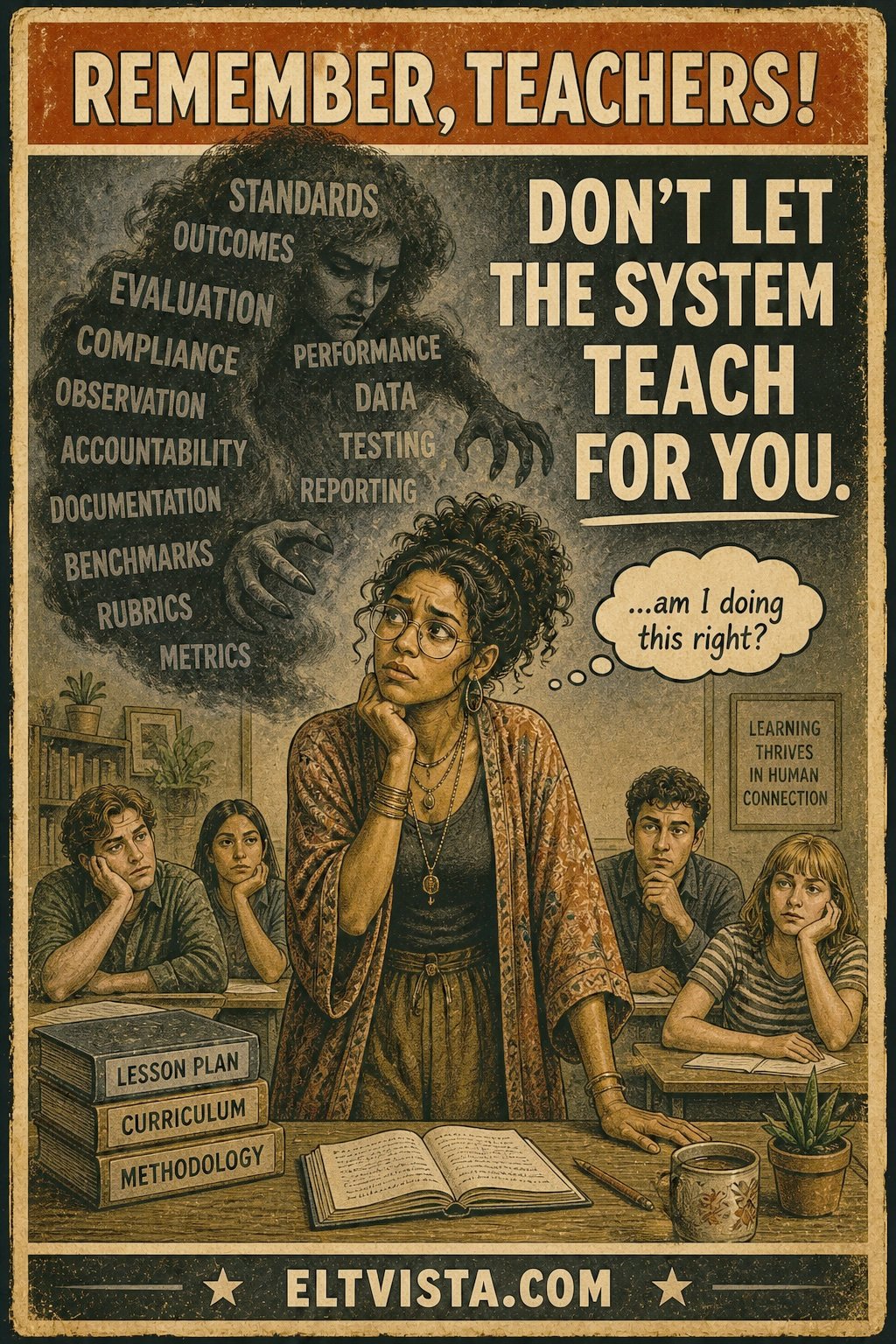
Extending the Moment of Hesitation
Stella Adler, acting coach and drama theorist, once remarked that “life beats down and crushes the soul, and art reminds you that you have one.” She was speaking in the context of the twentieth century, a period marked by war, economic depression, and the dislocations of modern life. Yet her observation continues to resonate today. Many writers have described modern society as an age of anxiety—a time in which institutions grow larger, systems become more complex, and individuals often find themselves navigating pressures that feel impersonal and difficult to influence.
Teachers, perhaps more than most professionals, recognize this condition. They encounter it not only in policy and institutional design, but in the daily negotiation between what is required and what is possible in the classroom.
The modern language teacher works within a dense web of expectations. Administrative structures demand documentation and measurable outcomes. Schools operate under financial pressures that often translate into part-time contracts, limited job security, and wages that struggle to keep pace with the cost of living. Experience—once considered the foundation of professional authority—can sometimes be treated as secondary to credentials, paperwork, or the latest fashionable methodology. Meanwhile, the broader culture celebrates entertainers, athletes, and now even social-media influencers with enthusiasm that rarely extends to those whose work quietly shapes the intellectual and human development of others.
And still, teachers continue to show up in classrooms every day.